
Best Product Feed Management Software in 2026 (Compared)
Manually managing product feeds across Google, Meta, and TikTok wastes hours of your time. Worse, it causes costly errors that kill your return on ad spend (ROAS). When your product data is wrong, your ads either get rejected or shown to the wrong people.
This guide compares the 8 best product feed management software tools in 2026 based on features, pricing, Shopify support, and AI capabilities. By the end, you will know exactly which platform fits your store's needs.
Quick Summary
Feedon.ai: The best overall for Shopify brands, offering native integration and fully automated AI optimization.
DataFeedWatch: A robust choice for mid-market agencies handling multiple client accounts.
Feedonomics: Built for enterprise retailers with complex, massive catalogs.
Channable: Excellent for European ecommerce brands needing local marketplace connections.
GoDataFeed: Great for multi-channel sellers focused heavily on Amazon and Google.
AdNabu: Ideal for smaller Shopify stores running Google Ads on a tight budget.
Productsup: Highly scalable for large enterprise commerce teams.
Shopping Feed: A solid entry-level tool for small merchants just starting out.
What is product feed management software?
Product feed management software is a tool that automatically pulls product data from your store and formats it perfectly for different advertising channels. Instead of manually updating spreadsheets, this software syncs your inventory, pricing, and product details in real time. It takes your raw product catalog and optimizes and publishes it to Google Shopping, Meta Catalog, TikTok Shop, Amazon, and more.
Why manual feed management fails at scale
Relying on spreadsheets for your feeds breaks down quickly as you grow. Here is why manual management fails:
Wrong titles: Manual titles rarely match what shoppers actually search for.
Missing attributes: Forgetting details like colour, size, or GTIN drops your visibility.
Channel rejections: Ad platforms will instantly suspend your items if formatting rules are broken.
No algorithm optimization: Each channel has a unique algorithm, and a one-size-fits-all manual feed cannot adapt to them all.
one-size-fits-all manual feed cannot adapt to them all.
What to look for in a feed management tool
When choosing data feed management software, you need a tool that actually saves you time. Keep these five criteria in mind:
Channel coverage: Does it support the specific ad networks and marketplaces you use?
Shopify integration: Does it connect directly to your store without messy file uploads?
AI optimization: Can it automatically rewrite titles and extract missing attributes?
Pricing: Does the cost align with your total SKU count and budget?
Support: Is the onboarding process guided, or are you left to figure it out alone?
Best product feed management software — quick comparison (2026)
Tool              Best for                   Shopify     AI features     Starting price
Feedon.ai         Shopify + AI-first brands  Native      Yes – full AI   Free trial
DataFeedWatch     Mid-market agencies        Yes         Limited         $59/mo
Feedonomics       Enterprise retailers       Yes         Limited         Custom
Channable         European eComm             Yes         No              €39/mo
GoDataFeed        Amazon + Google sellers    Partial     No              $39/mo
AdNabu            Shopify Google ads         Native      Basic           $29/mo
Productsup        Enterprise commerce        Yes         Limited         Custom
Shopping Feed     Small merchants            Yes         No              $29/mo
1. Feedon.ai — best AI-powered product feed management software for Shopify

Feedon.ai is the only AI-native feed management tool built specifically for Shopify. Instead of just mapping your data, it actively improves it, rewriting titles and optimizing formats for Google, Meta, and TikTok automatically.
Key features
AI attribute extraction from product descriptions and images
Built-in creative studio for ad visuals
Automated feed auditing to prevent disapprovals
One-click background removal for product images
Seamless multi-channel publishing
Pros and cons
Pros:
Native, frictionless Shopify integration
True AI optimization does the heavy lifting for you
Excellent interface that requires no technical skills
Cons:
Focuses primarily on Shopify (not ideal for custom-built stores)
Newer to the market compared to legacy enterprise tools
Advanced creative studio features take a little time to master
Pricing
Feedon.ai offers a free trial so you can test the AI features before committing. Paid plans scale affordably based on your needs. Check out the pricing page for details.
Best for
Shopify brands that want AI-optimized feeds without a 6-month onboarding process.
Looking for a Feedon.ai alternative? See our full comparison → feedon.ai comparison
2. DataFeedWatch — best for agencies managing multiple client feeds

DataFeedWatch is a veteran in the feed management space, offering robust rules and mappings that give marketing agencies tight control over multiple client accounts.
Key features
Rule-based feed mapping
Support for over 2,000 global channels
Agency dashboard for multi-account management
Feed review and error reporting
Pros and cons
Pros:
Great agency features and sub-accounts
Massive list of supported channels
Reliable customer support
Cons:
User interface feels slightly dated
AI features are limited compared to newer tools
Steeper learning curve for beginners
Pricing
Plans start at $59 per month for basic store setups, scaling up for agency features.
Best for
Mid-market agencies that need to manage dozens of distinct client catalogs from one dashboard.
Looking for a DataFeedWatch alternative? See our full comparison → datafeedwatch comparison
3. Feedonomics — best for enterprise retailers

Feedonomics is a heavy-duty platform known for its white-glove service. It handles massive, complex catalogs for some of the biggest retailers in the world.
Key features
Full-service feed setup and management
Advanced data governance and error resolution
Inventory syncing across global marketplaces
Custom API integrations
Pros and cons
Pros:
White-glove service means they do the work for you
Handles millions of SKUs easily
Incredibly reliable for complex setups
Cons:
Very expensive, not suitable for small or mid-sized brands
Setup times can take weeks or months
You cannot easily make quick changes yourself
Pricing
Custom pricing only, typically starting in the thousands of dollars per month based on SKU volume.
Best for
Massive enterprise brands with complex inventory setups who want fully managed service.
Looking for a Feedonomics alternative? See our full comparison → feedonomics comparison
4. Channable — best for European ecommerce brands

Channable is a widely used tool in Europe, combining data feed management with search engine advertising (SEA) automation.
Key features
Combined feed management and PPC ad creation
Order syncing for specific marketplaces
Built-in dynamic text ads generator
Extensive European marketplace support
Pros and cons
Pros:
Deep integrations with European channels (Bol.com, Amazon EU)
Useful PPC automation tools included
Clear and logical rule builder
Cons:
Lacks advanced AI optimization
Customer support can be slow in US time zones
Add-ons can make pricing jump quickly
Pricing
Starts at €39 per month, with additional costs for higher item limits and order syncing.
Best for
European ecommerce brands that want to manage feeds and dynamic search ads in one place.
Looking for a Channable alternative? See our full comparison → channable comparison
5. GoDataFeed — best for Amazon + Google multi-channel selling
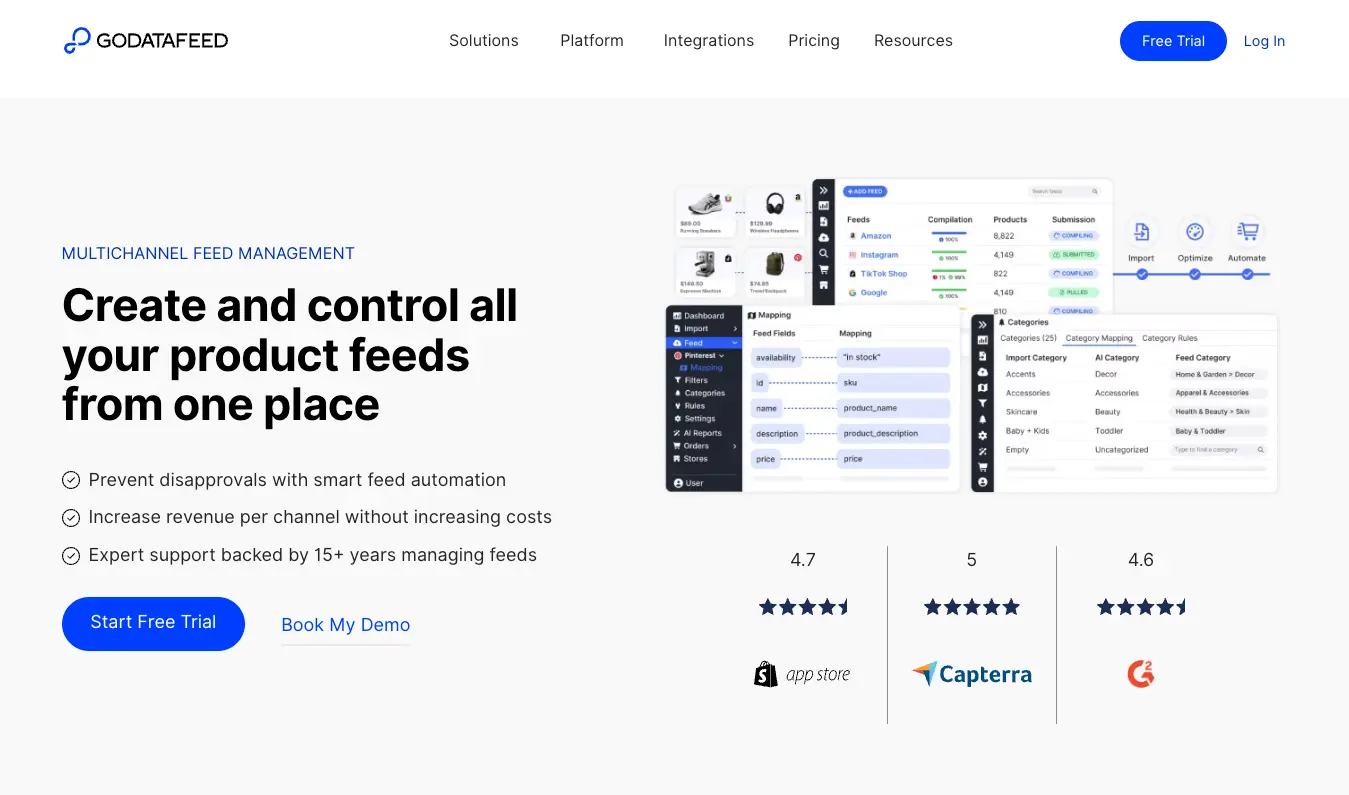
GoDataFeed bridges the gap between your store platform and major marketplaces like Amazon, making it easy to sync products and variations.
Key features
Pre-built marketplace templates
Automated feed scheduling
Product variation management
Basic performance tracking
Pros and cons
Pros:
Affordable starting point
Good for sellers moving off just a single channel
Reliable marketplace templates
Cons:
Shopify integration is only partial compared to native apps
No AI optimization capabilities
Rule creation can be clunky
Pricing
Starts at $39 per month for the basic plan.
Best for
Merchants who primarily need a reliable connection to Google Shopping and Amazon.
Looking for a GoDataFeed alternative? See our full comparison → godatafeed comparison
6. AdNabu — best for Shopify Google Ads on a small budget

AdNabu is a dedicated Shopify app designed specifically to help smaller merchants get their products approved in Google Merchant Center.
Key features
Native Shopify integration
Google Merchant Center error auditing
Keyword suggestions for titles
Multi-language and currency support
Pros and cons
Pros:
Very easy to install via Shopify App Store
Great entry-level price
Specifically tailored to Google Shopping success
Cons:
Limited functionality beyond Google Ads
Basic AI features compared to full AI suites
Not built for massive catalogs
Pricing
Plans start at $29 per month.
Best for
Smaller Shopify merchants who want an affordable, easy way to manage Google Ads feeds.
Looking for an AdNabu alternative? See our full comparison → adnabu comparison
7. Productsup — best for large enterprise commerce teams

Productsup is a highly technical platform that allows large teams to map, structure, and distribute product content across thousands of global touchpoints.
Key features
Visual drag-and-drop data mapping
Product-to-consumer (P2C) network syndication
Image and video feed designer
Enterprise-grade security and permissions
Pros and cons
Pros:
Incredibly powerful data transformation abilities
Great visual interface for complex data sets
Highly scalable for global operations
Cons:
Prohibitive pricing for most businesses
Long implementation and training process
Overkill if you just need Google and Meta feeds
Pricing
Custom pricing based on business requirements.
Best for
Global enterprise brands with dedicated commerce teams handling syndicated product data.
Looking for a Productsup alternative? See our full comparison → productsup comparison
8. Shopping Feed — best for small merchants starting out

Shopping Feed offers a straightforward solution to connect a storefront to major marketplaces and ad networks without overwhelming users with complex rules.
Key features
Order syncing back to the storefront
Auto-removal of out-of-stock items
Simple marketplace mapping
Centralized dashboard
Pros and cons
Pros:
Very user-friendly for beginners
Helpful support team
Handles basic marketplace order syncing well
Cons:
Lacks any AI features
Optimization tools are quite basic
Can become expensive as your SKU count grows
Pricing
Starts at $29 per month.
Best for
Small merchants who need a simple plug-and-play solution without advanced customization.
Looking for a Shopping Feed alternative? See our full comparison → Comparison
How to choose the right product feed management software for your store
Selecting the right feed management solution comes down to your platform, budget, and catalog size.
If you're on Shopify
We strongly recommend Feedon.ai or AdNabu. Native Shopify integration matters because it ensures real-time syncing of inventory and pricing without relying on manual CSV exports or delayed API calls. Feedon.ai offers the most powerful feature set for Shopify users.
If you manage multiple client feeds (agency)
DataFeedWatch is your best bet. Its agency-friendly dashboard and flexible rule mappings allow you to handle diverse client needs efficiently from a single login.
If you're an enterprise brand
Feedonomics or Productsup will serve you best. These platforms have the infrastructure to handle millions of SKUs and the dedicated support teams required for massive retail operations.
If budget is the priority
GoDataFeed or AdNabu are the best starting points. Both offer low monthly costs while providing the essential tools needed to get your products approved on Google and other major networks.
If you want AI-first optimization
Feedon.ai is the clear winner here. Feedon.ai is the only tool in this list with built-in AI attribute extraction and background removal. None of the competitors offer a truly automated, AI-native approach to rewriting your titles and optimizing your data.
Frequently asked questions about product feed management software
Q1: What is the best product feed management software in 2026?
Answer: Feedon.ai is the best for Shopify brands due to its AI-native approach. DataFeedWatch is best for agencies, Feedonomics for enterprise. Depends on your store size and channels.
Q2: What does product feed management software do?
Answer: It takes your product catalog and optimizes it for each ad channel (Google Shopping, Meta, TikTok, Amazon) — fixing titles, adding missing attributes, and publishing automatically.
Q3: Is there a free product feed management tool?
Answer: Most tools offer free trials. Feedon.ai offers a free trial. Google Merchant Center is free but does not optimize feeds — it just ingests them.
Q4: What is the difference between DataFeedWatch and Feedonomics?
Answer: DataFeedWatch is better for agencies and mid-market brands. Feedonomics is enterprise-focused with custom pricing. Link to the full comparison article here.
Q5: Does product feed software work with Shopify?
Answer: Yes — most tools integrate with Shopify. Feedon.ai and AdNabu are built natively for Shopify. Others connect via API or CSV export.
Q6: How much does feed management software cost?
Answer: Range from $29/mo for basic tools to custom enterprise pricing. Feedon.ai, GoDataFeed, and AdNabu are the most affordable starting points.
Q7: What is the best feed management tool for Google Shopping?
Answer: Feedon.ai's AI title optimization is built specifically for Google Shopping ranking. DataFeedWatch also has strong Google Shopping rules. Both are solid choices.
which product feed management software should you use?
Your choice ultimately depends on your specific business model. If you run a Shopify store and want the massive time-saving benefits of AI, Feedon.ai is your best bet. If you run an agency managing dozens of client accounts, DataFeedWatch gives you the control you need. If you operate an enterprise business with millions of SKUs, Feedonomics offers the white-glove service required. Finally, if you are just starting out and budget is your absolute main priority, AdNabu provides a great entry point.