
How AI is Changing Product Feed Management (2026)
For most of the past decade, e-commerce product feed management was treated as a plumbing problem. You connected your store to a feed management platform, mapped your fields, scheduled an update, and moved on. If the feed was technically valid and prices were correct, the job was done.
That approach no longer works.
In 2026, the rules of product discovery have been rewritten entirely. Google's AI Overviews, conversational shopping assistants, and machine learning ranking systems have fundamentally changed how products get found, evaluated, and selected. Your product data feeds are no longer just a technical export. They are the primary signal that determines whether your products get discovered at all.
This guide breaks down exactly what has changed, how AI is transforming data feed management, what the evolution of Google Merchant Center means for your catalog, and what steps you need to take right now to stay competitive.
What Is Feed Management, and Why Has It Become So Complex?

Before diving into how AI is changing things, it helps to understand what feed management actually means in the modern e-commerce context.
What is feed management?
At its simplest, feed management is the process of collecting, standardising, enriching, and distributing your product data to various sales and advertising channels. A product data feed is a structured file containing all the information about your products, including titles, descriptions, prices, availability, images, and attributes, formatted in a way that platforms like Google, Meta, and Amazon can read and use.
Data feed management covers the full lifecycle of that data, from the moment it leaves your backend system to the moment it appears in front of a potential buyer. For small catalogs, this might mean a simple spreadsheet sync. For large retailers managing tens of thousands of SKUs across multiple channels, it requires a dedicated feed management platform and a serious strategy.
The complexity has grown because the channels consuming your ecommerce product data feeds are no longer passive. They are actively intelligent. Google does not just display your products anymore. It evaluates them, ranks them, predicts their relevance to specific queries, and decides whether to feature them in AI-powered results. The quality of your product data feed solution directly determines the outcome of that evaluation.
The Old Model of Data Feed Management Is Broken
Traditional products' feed management was built around one goal: distribution. Get the right data into the right format and push it out to every channel on schedule. Platforms built for this purpose do that job well. They centralise product data, normalize attributes across channels, and keep pricing and availability accurate.

What they cannot do is make your products win.
Winning in 2026 requires something different. It requires product feed enrichment, intelligent attribute extraction, and continuous optimization driven by real performance signals. The merchants who treat their e-commerce product feed management as a set-and-forget operation are losing visibility every single day to competitors who have made their feeds a core marketing asset.
The data gap is striking. Research consistently shows that the average e-commerce store has between 30 and 50 per cent of its optional product attributes left blank. Missing colour, material, size, gender, pattern, and product type information limits how precisely Google can match your products to buyer searches. A feed that is technically valid but commercially thin is still a weak feed. AI changes this equation completely.
How AI Is Transforming Product Feed Enrichment

Product feed enrichment is the process of adding depth, completeness, and commercial context to your product data beyond the bare minimum required for submission. It is where AI has had the most dramatic impact in 2026.
Automated attribute extraction is now the most powerful tool available in modern e-commerce product feed management. AI systems use computer vision to analyse your product images and extract attributes that your backend simply does not store. A single photo of a striped linen blazer can yield its colour, pattern, material, fit, gender, and style classification, all populated automatically into the correct fields in your product data feed. This kind of enrichment used to require hours of manual data entry per category. AI handles it in seconds per SKU.
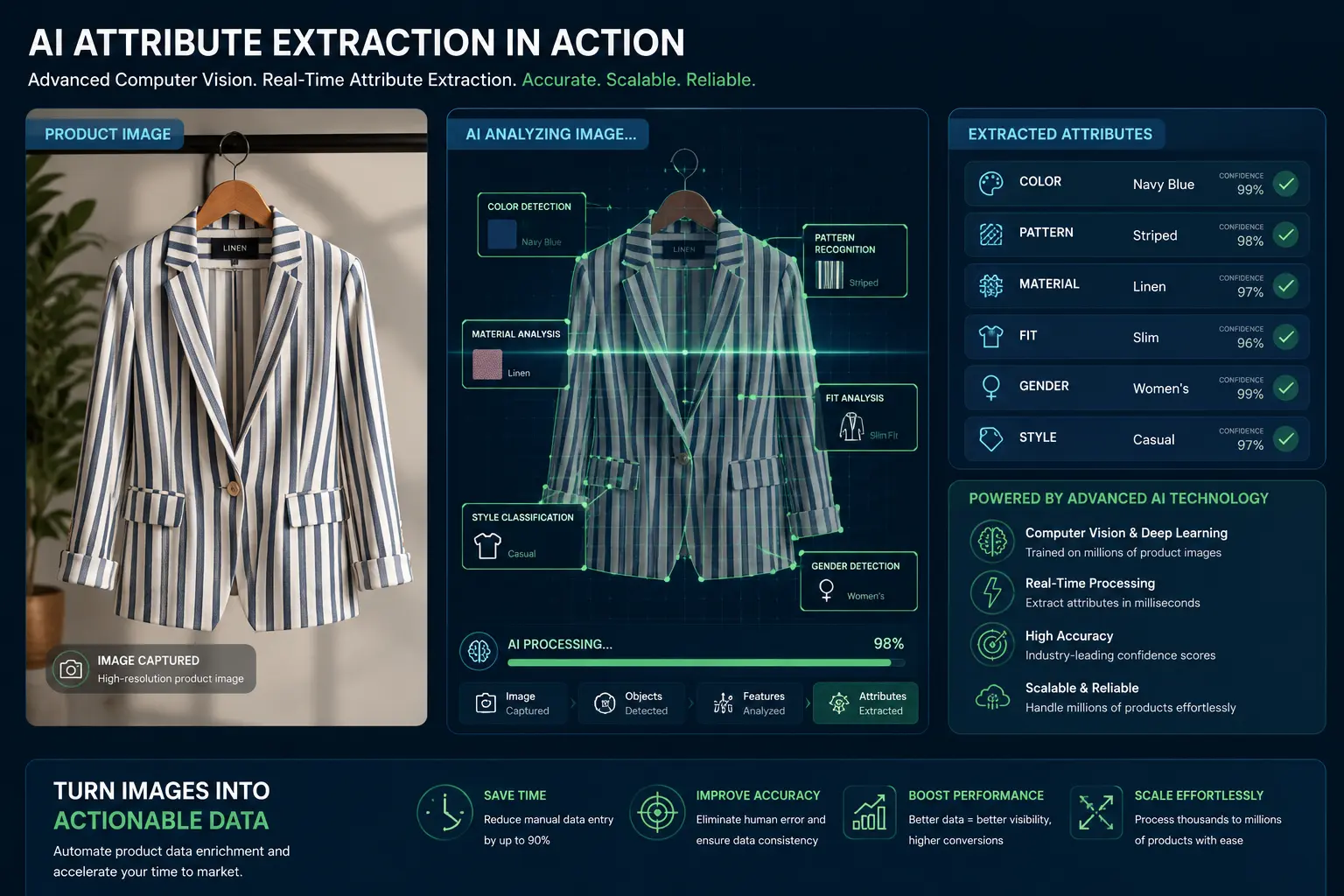
Natural language processing works alongside computer vision to extract specifications from unstructured product descriptions. If your description mentions a 400-thread-count cotton fabric or a 5,000 mAh battery but those details are not stored as structured attributes, AI can read the text and populate the correct fields. This means your product feed optimisation efforts can now reach attributes that were previously invisible to your team.
Intelligent title rewriting is another major application. Google places enormous weight on product titles for relevance matching, but many merchants simply export their internal product names without reformatting them for search. AI systems trained on conversion data and search patterns can automatically restructure titles to follow the brand, gender, product type, and attribute formula that Google rewards, at scale, across thousands of products simultaneously.
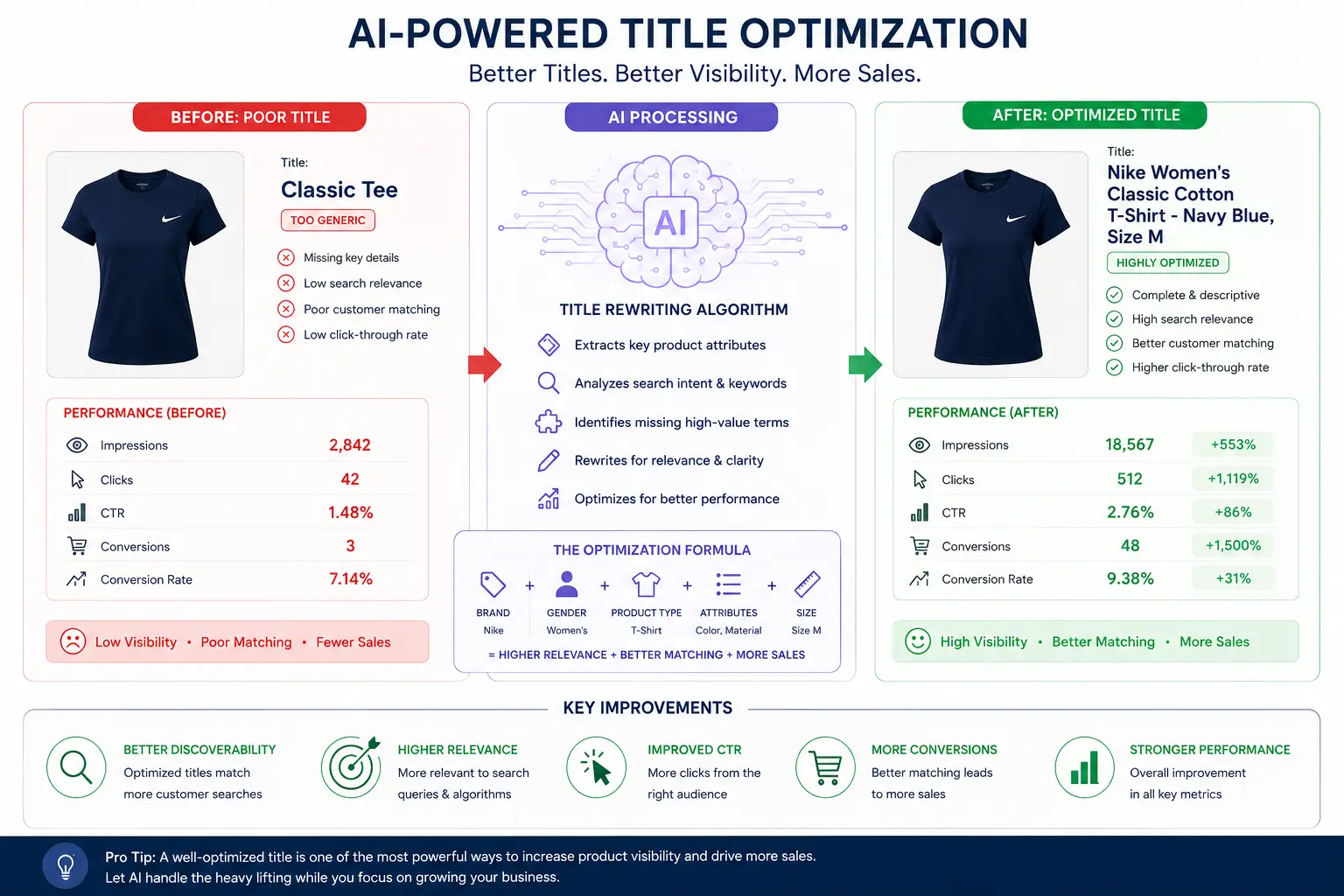
The cumulative effect of these improvements is significant. Stores that move from 70 per cent attribute completion to 95 per cent or above consistently see meaningful improvements in both ad visibility and conversion rates. AI makes achieving that level of completeness operationally realistic for the first time.
Google Merchant Center: Definition, Features, and Benefits
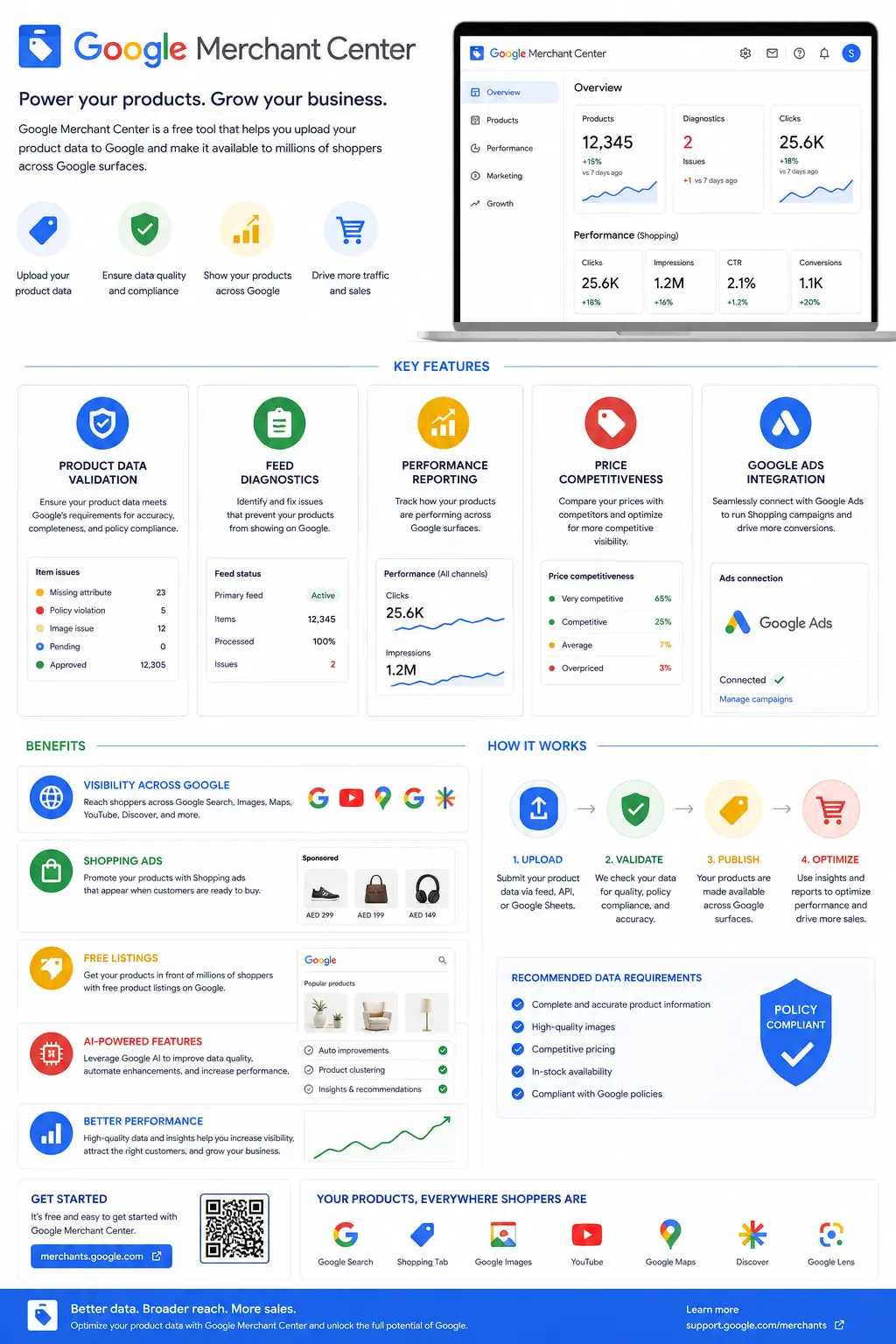
No conversation about product data feeds in 2026 is complete without understanding where those feeds actually live. Google Merchant Center is the platform Google built to allow retailers to upload and manage their product data for use across Google's shopping ecosystem.
Understanding the Google Merchant Center definition, features, and benefits is essential for anyone running Google Shopping campaigns.
At its core, Google Merchant Center acts as the bridge between your inventory and Google's advertising products. You submit your ecommerce product data feed to Merchant Center, and Google uses that data to power Shopping ads, free product listings, Performance Max campaigns, and increasingly, AI-powered search features like Shopping in AI Overviews.
The key features include product data validation, feed diagnostics, performance reporting, price competitiveness tools, and integration with Google Ads for campaign management. The core benefit is visibility: a well-maintained Google Merchant Center account puts your products in front of buyers at the exact moment they are ready to purchase, without requiring you to bid on specific keywords.
Google Merchant Center vs Merchant Center Next: What Changed
The Google Merchant Center vs Merchant Center Next conversation is one that every serious ecommerce merchant needs to understand in 2026, because the two platforms represent a fundamental change in how Google thinks about product data.

The classic Google Base Merchant Center, which many merchants have been using for years, was built primarily around feed submission and campaign management. It separated product data from performance insights, requiring merchants to jump between Merchant Center and Google Ads to get a complete picture of how their products were performing.
Merchant Center Next consolidates everything. The new interface merges product data management with performance analytics, making it easier to identify which products have low-quality data, which are being disapproved, and which are underperforming despite being technically valid. It also gives Google more direct visibility into your product content quality, which means the bar for what constitutes a strong merchant center product feed has effectively been raised.
The shift from Google Base Merchant Center to Merchant Center Next also signals Google's broader move toward AI-native shopping infrastructure. The platform now has deeper integration with Performance Max, better automated feed improvement suggestions, and tighter connections between your product data feeds and Google's machine learning systems. Merchants who have not migrated and updated their data feed management practices for this new environment are working against themselves.
What a Modern Feed Management Platform Must Do in 2026
Given how much has changed, choosing the right product data feed solution is a more consequential decision than it has ever been. The right feed management platform in 2026 needs to do far more than distribute data on a schedule.

It needs to actively improve the quality of your ecommerce product data feeds through AI-powered enrichment. It needs to provide real-time syncing so that pricing and availability are always accurate in your Google Merchant Center feed. It needs to surface performance signals and translate them into actionable feed optimizations. And it needs to do all of this at scale, across your entire catalog, without requiring your team to manually review thousands of SKUs.
The best platforms available today combine product feed enrichment automation, title and description optimization, attribute extraction, category mapping, and feed health monitoring in a single interface. They connect directly to your ecommerce platform and push changes to Google Merchant Center in real time, eliminating the lag that causes disapprovals and stock discrepancies.
For merchants evaluating options, the key questions to ask any product feed management company are whether they offer AI-driven enrichment, how they handle attribute gaps, how often they sync with Merchant Center, and what their approach is to ongoing product feed optimisation rather than one-time setup.
The Role of AI in Ongoing Product Feed Optimisation
One of the most important shifts AI has enabled is moving product feed optimisation from a one-time task to a continuous process. In the old model, a merchant might optimize their feed during initial setup and then revisit it quarterly. In 2026, feed optimization is effectively a real-time operation.
AI systems monitor performance signals continuously. They track impression share, click-through rate, conversion rate, and disapproval patterns across every SKU in your catalog. When a product starts underperforming, the system identifies whether the cause is a weak title, a missing attribute, a pricing discrepancy, or a categorization issue, and generates a recommendation or applies a fix automatically.

This kind of continuous loop between performance data and feed content is what separates a static ecommerce product data feed from a truly optimized one. It means your feed is always moving toward better alignment with what buyers are actually searching for, rather than reflecting how your products were described when you first loaded them into the system.
For large catalogs, this is the only operationally viable approach. Manually monitoring and updating product data feeds for five thousand or ten thousand SKUs is simply not possible at the speed and consistency that modern data feed feed management requires.
What Merchants Need to Do Right Now
Understanding that AI is transforming e-commerce product feed management is only useful if it leads to concrete action. Here is what merchants who are serious about their performance should prioritize immediately.
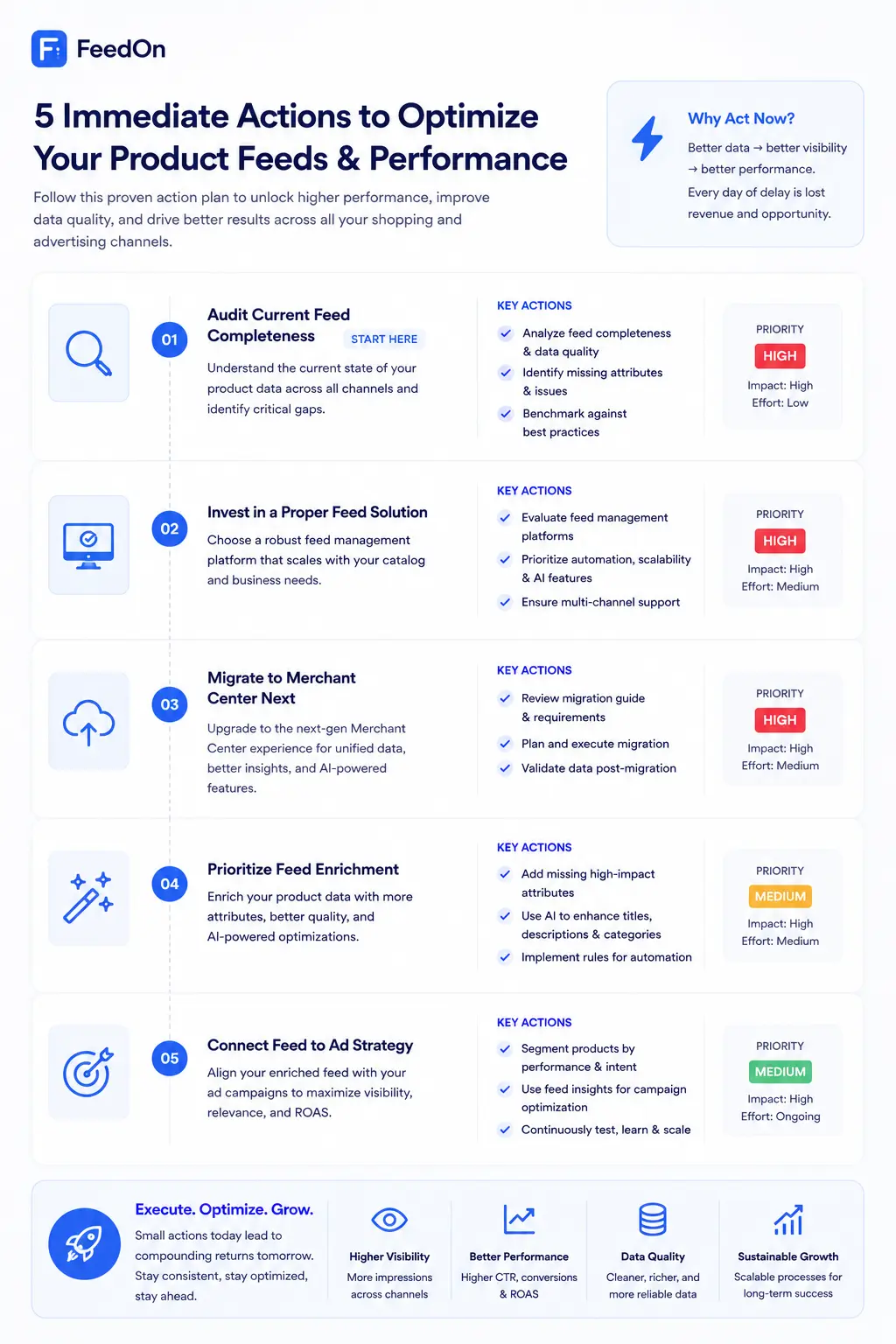
Audit your current feed completeness. Open your Google Merchant Center account and look at your feed diagnostics. Identify which attributes have the highest gap rates across your catalog. Missing colour, size, material, product type, and gender attributes are the most common culprits and the most impactful to fix.
Invest in a proper product data feed solution. If you are still managing your e-commerce product data feed through manual exports or basic integrations, you are leaving significant performance on the table. A modern feed management platform with AI enrichment capabilities pays for itself quickly through improved visibility and lower cost-per-acquisition.
Migrate to and fully utilize Merchant Center Next. If you are still operating on the legacy Google Base Merchant Center interface, transition to Merchant Center Next and familiarize yourself with its enhanced diagnostics. The platform gives you direct visibility into the data quality issues that are suppressing your performance.
Treat product feed enrichment as a priority, not a one-time task. Product catalogs change constantly. New products arrive with incomplete supplier data. Seasonal trends shift what attributes matter. A product feed management company or platform that handles enrichment automatically keeps your catalog commercially strong without demanding constant manual attention from your team.
Connect your feed performance to your ad strategy. Your product data feeds and your campaign structure should inform each other. Products with strong, complete data deserve aggressive bidding. Products with thin feeds need enrichment before spend increases. Aligning your products feed management strategy with your media strategy is how you avoid wasting budget on listings that cannot convert.
The Future of Feed Management Is Performance-First
The fundamental shift happening in 2026 is a move away from thinking about data feed management as infrastructure and toward treating it as a performance lever. The merchants who internalize this shift will build a compounding advantage over time. The ones who stick with legacy approaches will find themselves increasingly invisible as AI-native shopping systems favor richer, more complete, and more continuously optimized data.
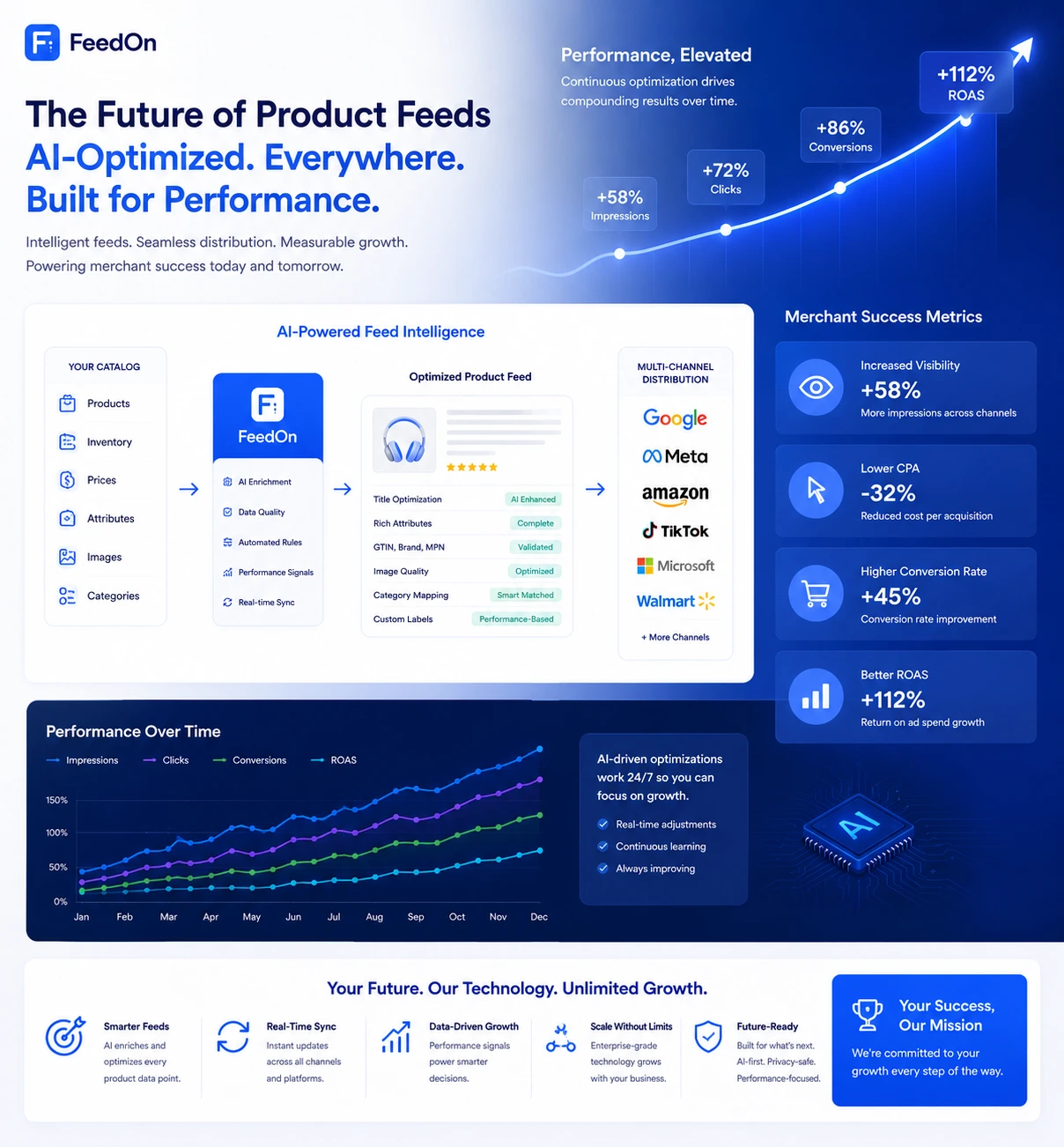
AI has made it possible to maintain a genuinely high-quality ecommerce product feed management operation at any catalog size. It has removed the manual bottleneck that previously meant only large enterprises with dedicated teams could compete on feed quality. That democratization is significant, but it also means the baseline is rising for everyone.
The question is no longer whether AI belongs in your product data feed strategy. It clearly does. The question is how quickly you build it into your operations before the gap between you and your competitors becomes too wide to close.
Frequently Asked Questions
What is feed management in ecommerce?
Feed management is the process of collecting, organizing, enriching, and distributing your product data feeds to advertising and sales channels like Google, Meta, and Amazon. It covers everything from initial data formatting and attribute mapping through to ongoing quality monitoring and product feed optimisation. A modern feed management platform automates most of this process using AI.
What is the difference between Google Merchant Center and Merchant Center Next?
The original Google Base Merchant Center focused primarily on feed submission and basic campaign linking. Merchant Center Next consolidates product data management and performance analytics into a single unified interface, with deeper integration into Performance Max and Google's AI-driven shopping features. Understanding Google Merchant Center vs Merchant Center Next is important because the new platform has raised the quality standards for product data feeds.
What is product feed enrichment?
Product feed enrichment is the process of adding missing attributes, improving descriptions, enhancing titles, and expanding the commercial context of your ecommerce product data feed beyond what your backend system automatically provides. AI-powered enrichment tools can extract attributes from product images and unstructured text automatically, dramatically improving feed completeness without manual data entry.
How often should I update my product data feeds?
For most e-commerce stores, real-time or near-real-time syncing is the right goal. Prices and availability change frequently, and any discrepancy between your Google Merchant Center product feed and your live website triggers disapprovals and damages your account health. A reliable product data feed solution should push updates to your merchant center feed automatically whenever inventory or pricing changes occur.
What should I look for in a product feed management company?
The right product feed management company should offer AI-powered attribute enrichment, automated title and description optimization, real-time data syncing with Google Merchant Center, feed health monitoring, and ongoing product feed optimisation rather than a one-time setup service. They should also have clear experience with e-commerce product feed management at your catalog scale and category type.
How does AI improve product feed optimisation?
AI improves product feed optimisation through automated attribute extraction from images and text, intelligent title rewriting based on search performance data, continuous monitoring of feed health and disapprovals, dynamic category mapping across Google's taxonomy, and real-time adjustment of feed content based on conversion signals. The cumulative result is a higher-quality e-commerce product data feed that performs better across both paid and organic shopping placements.