
Best DataFeedWatch Alternatives for Smarter Feed Management
Managing an online store requires juggling many moving parts simultaneously. One of the most critical elements for your advertising success is your product data feed. Your product feed acts as the bridge between your online store and massive sales channels like Google Shopping, Meta, and TikTok. If your data is messy, incomplete, or formatted incorrectly, your ads will fail to perform.
Many e-commerce businesses start their journey using DataFeedWatch to manage this complex process. It is a well-known tool that helps merchants map their store data to specific channel requirements. However, as your business scales, you might notice the limitations of traditional, rule-based feed management platforms. You might find yourself spending hours writing manual rules or dealing with constant product disapprovals.
If you are frustrated with manual spreadsheet gymnastics, you are not alone. Many modern e-commerce brands are searching for smarter, more automated solutions. In this guide, we will explore why businesses move away from traditional feed tools, the top features you need, and the best DataFeedWatch alternatives available right now.
Why Look for Alternatives to DataFeedWatch
DataFeedWatch offers a solid foundation for mapping data from your store to advertising channels. Yet, it operates primarily as a data-moving tool. It takes the information you already have and rearranges it to fit a template. This approach presents several challenges for growing businesses.
First, traditional tools rely heavily on manual rule creation. You have to build complex "if/then" statements to categorize your products correctly. If you manage hundreds or thousands of items, building and maintaining these rules becomes incredibly time-consuming. You end up managing the tool rather than managing your marketing strategy.
Second, rule-based platforms cannot create data out of thin air. If your Shopify store lacks a specific color or material attribute, DataFeedWatch cannot fill in that blank automatically. Google Merchant Center frequently disapproves products for missing attributes like Global Trade Item Numbers (GTINs), color, or gender. When your feed tool only moves existing data, you still have to fix these gaps manually in your e-commerce backend.
Finally, pricing structures for legacy tools often become restrictive. As you add more products or want to test new channels, your monthly costs can increase sharply. Small to medium-sized businesses need flexible pricing that scales reasonably with their growth, rather than punishing them for adding more inventory.
The Hidden Costs of Bad Product Data
Before choosing a new platform, you must understand exactly how bad product data hurts your bottom line. Missing or poorly formatted information directly impacts your return on ad spend (ROAS).
When your titles are generic, you miss out on high-intent search traffic. A shopper searching for "Men's Slim Fit Blue Oxford Shirt" will not see your ad if your feed simply says "Blue Shirt." You lose the sale to a competitor who provided a richer, more detailed product title.
Furthermore, missing data triggers channel disapprovals. Google and Meta have strict requirements for product listings. If you fail to provide necessary details, these platforms simply will not show your ads. You end up paying for a feed management tool while your products remain invisible to potential buyers.
Top Features to Consider in a Feed Management Tool
Upgrading your feed management strategy means looking for software that actively improves your catalog. When evaluating DataFeedWatch alternatives, you should prioritize tools that offer these specific capabilities.
AI-Powered Optimization
Modern feed management relies on artificial intelligence. You want a tool that can rewrite your product titles and descriptions automatically. AI can structure your copy specifically for the channel you are targeting. For example, effective shopify google shopping feed optimization is completely different from what works on TikTok Shop. Your tool should generate channel-specific, keyword-rich copy effortlessly.
Automated Attribute Extraction
Missing data causes the majority of feed errors. Look for platforms equipped with computer vision AI. These advanced tools can scan your product images and instantly extract details like color, size, material, and pattern. Instead of typing these attributes manually, the software fills in the gaps for you, ensuring compliance with strict marketplace rules.
Comprehensive Feed Audits
You need to know what is broken before you can fix it. The best tools scan your entire catalog automatically when you connect your store. They should identify missing GTINs, broken image URLs, incorrect categories, and price mismatches. A proactive audit prevents you from pushing broken feeds to your advertising channels.
Seamless Multi-Channel Publishing
Managing separate feeds for Google, Meta, Pinterest, and TikTok drains your resources. Your chosen alternative must act as a central hub. It should allow you to manage one master catalog and automatically export optimized, channel-ready feeds to every platform you use.
Best Alternatives to DataFeedWatch
If you are ready to upgrade your product feed workflow, several strong contenders exist in the market. Here is a breakdown of the best alternatives to help you make an informed decision.
FeedOn

FeedOn represents the next generation of product feed management. Built specifically for Shopify brands and e-commerce stores scaling multi-channel ads, FeedOn does not just move your data around. It actively improves your product catalog using advanced artificial intelligence.
While traditional tools require manual optimization, FeedOn automates the heavy lifting. The platform connects directly to your store and runs an immediate feed audit. It spots every issue that could cause a Merchant Center disapproval.
FeedOn truly shines with its Vision AI capabilities. It scans your product photos to generate missing attributes automatically. If you forgot to list the material of a jacket, FeedOn identifies it from the image and adds it to the feed. Furthermore, it rewrites your titles and descriptions per channel. You get a highly optimized Google Shopping title and an engaging Meta description from a single product listing. With a limited plan that covers 200 products forever, FeedOn provides an incredible entry point for smarter feed management.
Channable
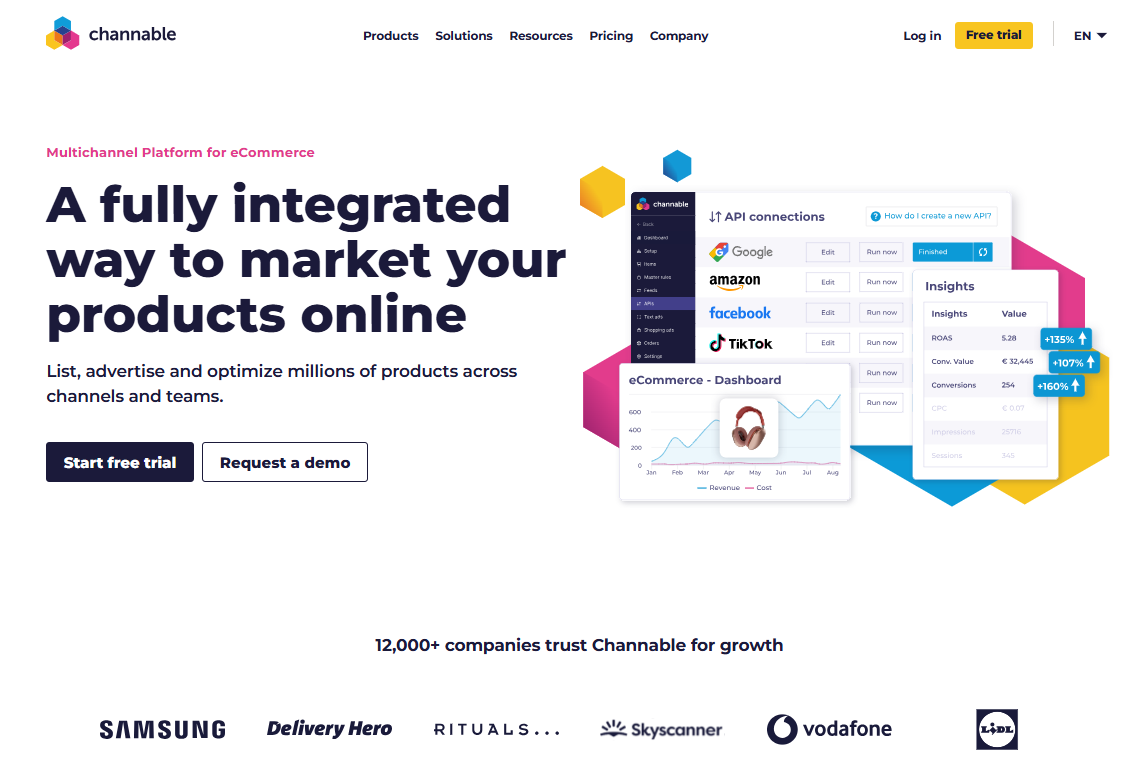
Channable is a robust alternative popular among large marketing agencies. It combines feed management with pay-per-click (PPC) automation. You can use Channable to build dynamic text ads for Google based directly on your product inventory.
This platform uses a highly logical, rule-based system similar to DataFeedWatch. It offers excellent flexibility if you enjoy building complex data filters. However, Channable still requires you to create those rules manually. It lacks the generative AI features that automatically write titles or extract missing image attributes, making it better suited for highly technical users.
Feedonomics

Feedonomics serves as the enterprise heavyweight in the feed management space. Instead of a self-service software platform, Feedonomics provides a full-service managed solution. You hand your data over to their team of specialists, and they handle the optimization for you.
This alternative works well for massive global brands with tens of thousands of SKUs and massive marketing budgets. The white-glove service ensures high quality, but it comes with a steep enterprise price tag. It also limits your internal team's ability to make quick, on-the-fly adjustments to your campaigns.
GoDataFeed

GoDataFeed is a straightforward, reliable tool that focuses heavily on channel templates. It offers hundreds of pre-built integrations for various marketplaces and advertising platforms. The interface is clean, making it slightly easier to navigate than DataFeedWatch for beginners.
Like Channable, GoDataFeed relies on traditional field mapping and manual rule creation. It is a highly capable tool for standard feed syndication. Yet, if your primary goal is to fix bad product data or automatically generate richer product titles, you will still need to do that work manually before importing your catalog.
Take the Next Step in Feed Management
Relying on outdated, manual feed management processes limits your e-commerce growth. You pay for ads that never show up because of missing attributes. You lose potential customers because your generic titles do not rank in search results.
Switching from a traditional mapping tool to a modern, AI-driven platform solves these exact problems. By leveraging artificial intelligence, you can turn a messy, incomplete product catalog into a high-performing asset across multiple sales channels.
Audit your current feed workflow today. Look closely at how much time your team spends fixing errors and writing rules. We encourage you to explore these smarter alternatives. Start by testing an AI-powered platform like FeedOn to see exactly how automated attribute extraction and channel-specific optimization can immediately improve your advertising results. Taking control of your product feed is the fastest way to boost your online sales.
Frequently Asked Questions
Why should I consider alternatives to DataFeedWatch?
While DataFeedWatch is a solid platform for moving data, growing e-commerce businesses often hit roadblocks as they scale. Traditional tools rely heavily on manual rules and cannot generate missing product attributes like specific colors or materials. Exploring alternatives helps you find modern solutions that automate tedious tasks, reduce spreadsheet errors, and prevent costly product disapprovals in Google Merchant Center.
What features should I look for in a feed management tool?
You need software that actively improves your catalog rather than just rearranging existing information. Prioritize platforms that offer AI-powered title and description optimization, automated attribute extraction from product images, comprehensive catalog audits, and seamless multi-channel publishing for networks like Google Shopping, Meta, and TikTok.
How does AI improve product feed optimization?
Artificial intelligence eliminates hours of manual data entry. Advanced AI tools instantly scan your product images to extract missing details, rewrite your titles to match specific search intents, and generate keyword-rich descriptions. This smart automation ensures your data always meets strict marketplace rules and reaches the right shoppers at the right time.
What are the benefits of using FeedOn over traditional tools?
FeedOn goes far beyond standard data mapping by using Vision AI to complete your product data automatically. If you forget to add a material or pattern to your store backend, FeedOn identifies it directly from the product photo and fills in the gap. It also generates custom, channel-specific copy to help you avoid disapprovals and capture more long-tail search traffic.
Can I use these alternatives with Shopify or WooCommerce?
Yes, top feed management alternatives integrate directly with major e-commerce platforms. FeedOn connects seamlessly with Shopify, WooCommerce, and various custom setups. Once connected, the software pulls your raw inventory data, optimizes it, and continuously syncs channel-ready feeds directly to your advertising platforms without any downtime.
How much do these alternatives cost?
Pricing varies widely depending on the specific software and the size of your product catalog. Legacy enterprise tools often cost hundreds or thousands of dollars a month. Modern alternatives provide much more flexible and scalable pricing. FeedOn, for example, offers a forever-free plan for up to 200 products, with paid plans starting at just $39 per month as your business grows.