
Best Productsup Alternatives for Smarter E-Commerce Feeds
Selling products across multiple online channels requires absolute precision. You must coordinate your website inventory with complex advertising networks like Google Shopping, Meta, Pinterest, and TikTok. Your product data feed serves as the critical bridge connecting your store to these massive platforms. When your feed contains highly accurate, rich data, your ad campaigns reach the exact shoppers who want to buy your items.
For years, massive global enterprises have used Productsup to manage this massive flow of inventory data. Productsup offers a highly complex, enterprise-grade platform designed to process millions of stock keeping units (SKUs) across endless global channels. It provides a massive sandbox for data engineers to build intricate data supply chains.
However, this heavy-duty infrastructure does not serve every brand perfectly. As your e-commerce business evolves, you might find that navigating such a complex system slows your marketing team down. You might spend weeks training new staff just to understand how to map a simple product attribute. If you feel bogged down by overly complicated interfaces or steep enterprise fees, you have other options.
In this comprehensive guide, we will explore exactly why growing brands pivot away from legacy enterprise software. We will break down the essential features you need for rapid growth and highlight the best Productsup alternatives available on the market right now.
Why Look for Alternatives to Productsup
Productsup excels at handling massive, tangled webs of global product data for Fortune 500 companies. Yet, the sheer scale of the platform often creates significant hurdles for agile e-commerce teams who need to move quickly.
Overwhelming Platform Complexity
The biggest challenge with Productsup lies in its incredibly steep learning curve. The platform caters heavily to IT professionals and data engineers rather than everyday marketers. If you want to launch a quick promotional campaign or tweak your product titles for a trending keyword, you have to navigate a maze of complex mapping rules. This structural complexity creates massive bottlenecks. Your marketing team ends up relying on technical specialists to make even the smallest adjustments to your product listings.
High Enterprise Costs
Enterprise software carries an enterprise price tag. Productsup requires a significant financial investment, often locking brands into massive annual contracts. For small to medium-sized businesses, or even mid-market brands looking to optimize their software spend, these high costs cut deeply into actual advertising budgets. You end up spending your hard-earned revenue on software overhead instead of spending it on acquiring new customers.
Lack of Built-in Generative AI
Legacy data routing platforms focus primarily on moving data from point A to point B. They take the raw data you already have and map it to a new destination. However, they struggle to create data out of thin air. If your Shopify or BigCommerce backend lacks crucial details like product materials, patterns, or exact colors, standard routing software cannot help you. You still have to do the manual labor of researching and typing out those missing attributes to satisfy Google Merchant Center requirements.
The Cost of Ignoring Feed Optimization
You must understand the real-world impact of your product data before you choose a new software provider. Advertising networks use your product feed to determine exactly when and where your ads should appear.
If your feed data is thin or poorly formatted, your products lose visibility. A shopper searching for a "Women's Red Leather Crossbody Bag" will likely never see your ad if your product title just says "Red Bag." You miss out on capturing that highly motivated buyer simply because your feed lacked descriptive keywords.
Worse yet, missing required data leads directly to account suspensions. Platforms like Google and TikTok enforce strict rules regarding product identifiers, pricing formatting, and required category attributes. If you upload a feed filled with blank fields, the networks will reject your items. Your ad spend drops to zero, and your revenue takes an immediate hit while you scramble to fix the errors.
Key Features to Consider in a Feed Management Tool
Moving away from a complicated enterprise tool means upgrading to a platform that actively improves your catalog. When evaluating Productsup alternatives, you must prioritize modern feed management software that offers automated, time-saving features.
Automated Attribute Extraction
Missing product details cause the vast majority of feed errors and disapprovals. Look for platforms equipped with advanced computer vision technology. These artificial intelligence tools scan your actual product photos and instantly extract critical details. The software can visually identify colors, specific patterns, materials, and target demographics. Instead of typing these details by hand for thousands of items, the AI fills in the gaps automatically.
AI-Driven Content Optimization
Your new feed tool should act as a specialized copywriter. It needs to automatically rewrite your product titles and descriptions based on the specific rules of each sales channel. A highly structured, text-heavy title works best for Google Shopping. Conversely, a snappy, engaging description performs better on social networks like Meta. The right software generates keyword-rich copy tailored to each platform without requiring any manual input from your team.
Proactive Catalog Auditing
You need complete visibility into the health of your product catalog before you send data to Google or Meta. The best alternatives automatically scan your entire inventory the moment you connect your store. They instantly highlight missing Global Trade Item Numbers (GTINs), broken image links, incorrect categories, and pricing errors. This proactive approach, essentially a real-time Google Shopping feed audit, prevents you from pushing bad data and facing sudden marketplace suspensions.
Intuitive User Interface
Your marketing team needs to own the feed strategy. Choose a platform with a clean, logical dashboard that does not require an advanced computer science degree to operate. When the interface is intuitive, your team can launch new channels, adjust data mapping, and optimize campaigns in minutes rather than weeks.
Best Alternatives to Productsup
If you are ready to leave complex enterprise routing behind, several highly capable platforms exist to take its place. Here is a detailed breakdown of the top tools to help you modernize your e-commerce feed strategy.
FeedOn
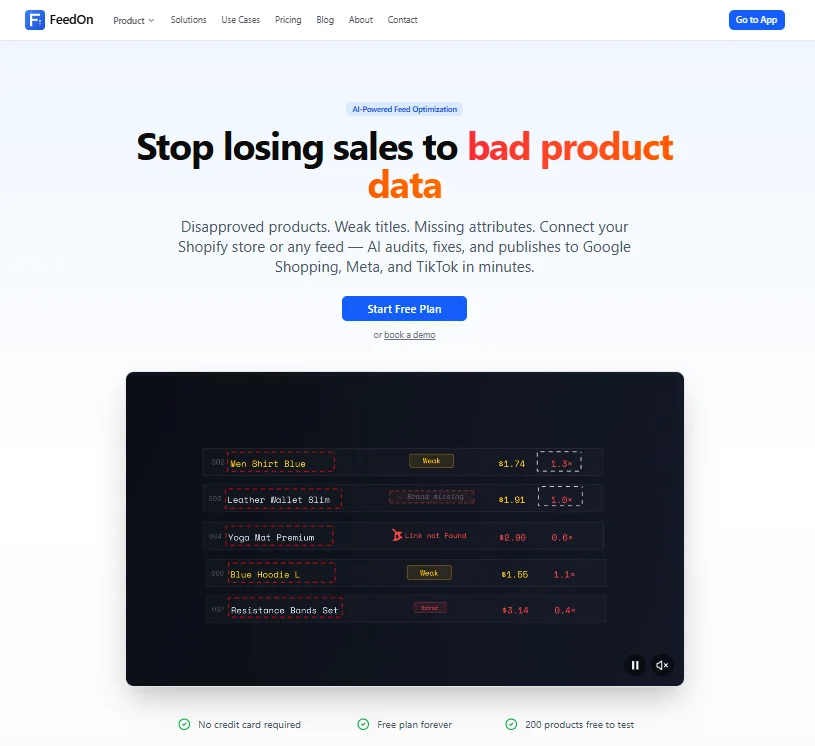
FeedOn represents a massive upgrade for brands that want true catalog optimization without the enterprise headache. Built specifically for e-commerce brands scaling multi-channel ads, FeedOn does not just map your existing data. It actively repairs, enriches, and improves your product catalog using advanced artificial intelligence.
While Productsup requires you to build complex rules to route data, FeedOn automates the entire optimization process. The platform connects directly to your online store, runs a deep catalog audit, and instantly flags every issue that could trigger a marketplace disapproval.
FeedOn truly shines with its Vision AI capabilities. It scans your product images to generate missing attributes completely hands-free. If you forgot to list the fabric type of a winter coat in your backend, FeedOn identifies the material from the photo and seamlessly adds it to your Google Shopping feed. Additionally, it rewrites your product titles and descriptions for each specific advertising channel. You get an optimized Google Shopping title and a high-converting Meta description generated from a single core product listing. With a feedon plan covering up to 200 products, FeedOn offers an incredibly accessible and powerful entry point for smarter feed management.
Channable
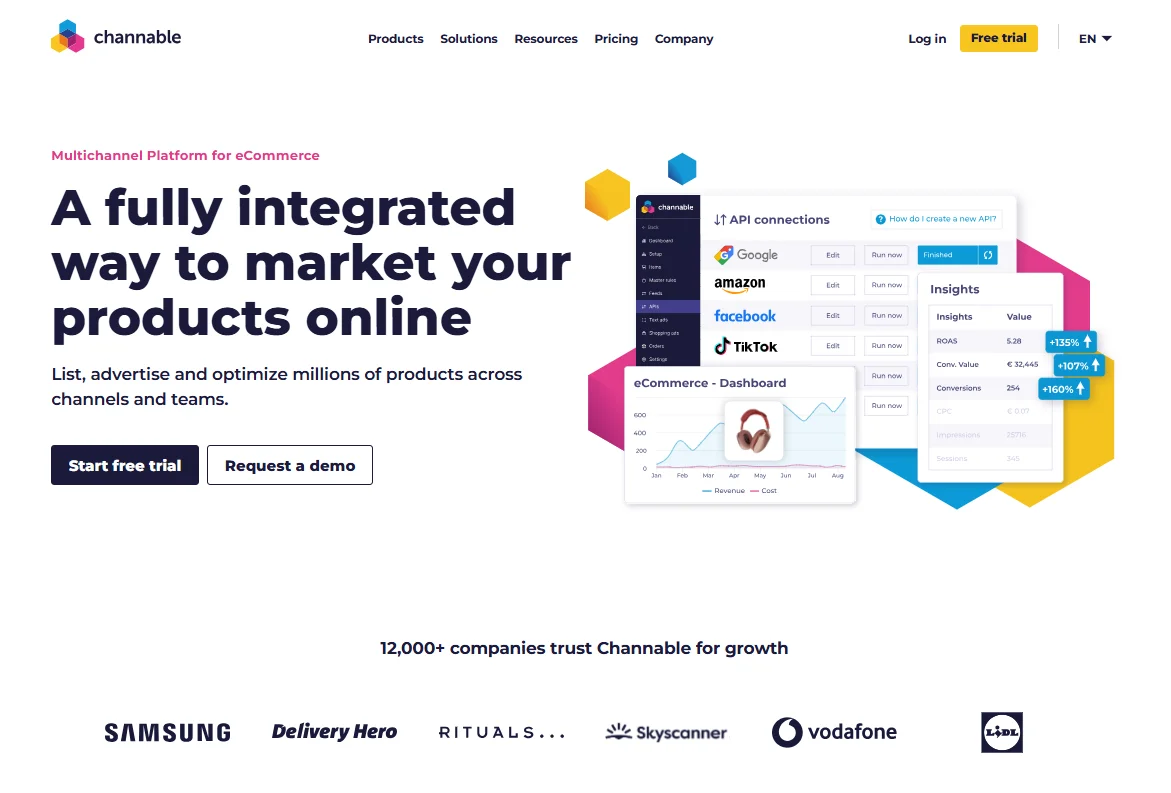
Channable is a robust, self-serve alternative that appeals heavily to marketing agencies and performance-driven teams. It combines comprehensive product feed management with powerful pay-per-click (PPC) automation tools. You can use Channable to build dynamic text ads for Google Search based directly on your real-time inventory levels.
This platform uses a highly logical, rule-based system. It offers excellent flexibility if you enjoy building complex "if/then" statements to categorize and filter your products. It puts the control directly in the hands of marketers, bypassing the need for heavy IT involvement. However, Channable still requires you to create those optimization rules manually. It lacks the generative AI features that automatically write new titles or extract missing image attributes, making it best suited for teams that already possess perfectly clean backend data.
DataFeedWatch

DataFeedWatch serves as a direct, lateral alternative for businesses looking for pure feed syndication without the massive enterprise cost. It focuses heavily on straightforward channel mapping and offers hundreds of pre-built templates for global marketplaces and advertising networks.
Like Channable, DataFeedWatch relies on a logic-based rule interface. It makes it incredibly easy to push your products to any channel imaginable. The dashboard remains clean, and the learning curve is relatively mild compared to Productsup. However, it still requires manual rule building and lacks the AI-driven content generation needed to fix deep catalog gaps automatically. It stands as an excellent choice for broad syndication, provided you are willing to manage the rule creation yourself.
Take the Next Step Toward Smarter Feed Management
Relying on overly complex, expensive enterprise software limits your brand's agility. You lose the ability to react quickly to market trends, and you drain your advertising budget on massive software fees.
Switching from a rigid data routing tool to a modern, AI-driven platform eliminates these exact frustrations. By leveraging artificial intelligence, you can transform an incomplete product catalog into a highly optimized sales asset across every major platform.
Review your current feed workflow and calculate how much time your team spends navigating complex mapping rules. We highly encourage you to explore these smarter alternatives. Start by testing an AI-powered platform like FeedOn. See firsthand how automated attribute extraction and channel-specific copy generation can instantly elevate your advertising results. Taking control of your product feed strategy with intuitive, powerful software remains the absolute best way to scale your online sales and maximize your revenue.
Frequently Asked Questions
Why should I consider alternatives to Productsup?
Productsup is a powerful enterprise platform, but it can be too complex and expensive for many growing brands. If your marketing team spends weeks trying to learn complicated data rules or if you are paying massive enterprise fees, you might want a simpler, more agile solution. Modern alternatives give you direct control over your product listings without the steep learning curve or heavy reliance on IT teams.
What features should I prioritize in a feed management tool?
You want software that actively upgrades your product catalog rather than just moving raw data around. Look for tools that offer automated attribute extraction, which pulls missing details right from your product photos. It is also important to prioritize AI-driven title rewriting and continuous catalog audits to catch errors before advertising networks suspend your account.
How does AI improve feed optimization?
Artificial intelligence removes the heavy manual labor from your daily workflow. Instead of typing out missing details by hand, AI scans your product images to find and fill in crucial information instantly. AI also rewrites your product titles and descriptions to perfectly match the specific search habits of buyers on platforms like Google Shopping, Meta, and TikTok.
What are the benefits of using FeedOn over Productsup?
FeedOn provides the power of advanced optimization without the enterprise headache. While Productsup requires technical experts to build complex data routing rules, FeedOn automates the process using visual AI. It actually generates missing data from your product photos and creates custom copy for different channels, helping you boost sales while saving countless hours of manual work.
Can these alternatives integrate with Shopify or WooCommerce?
Yes, the best feed management alternatives connect seamlessly with major e-commerce website builders. Platforms like FeedOn integrate smoothly with Shopify, WooCommerce, and various custom store setups. Once you connect your store, the software automatically pulls your raw inventory data, improves it, and continuously syncs the updated feeds straight to your advertising accounts.
What are the pricing options for these alternatives?
Pricing depends heavily on the software you choose and the total size of your product catalog. While legacy enterprise tools like Productsup often lock you into expensive annual contracts, modern alternatives offer highly flexible and scalable pricing. FeedOn, for example, provides a forever-free plan for up to 200 products, with paid tiers starting at a very accessible $39 per month as your business grows.