
Product Feed Management vs. PIM Software: The Definitive Guide
A real 3-year TCO comparison with actual vendor pricing across five growth stages. Concrete SKU, channel, & team-size thresholds for every stack decision. The first technical integration architecture diagram shows exactly how the PIM & feed manager connect. A data drift prevention SOP. How AI is blurring the PIM/feed management boundary, and where it isn't. Why B2B completely rewrites the PIM calculus. The MACH composable stack blueprint. An honest "when to skip PIM" assessment with governance debt timelines. And the combined ROI framework you can use to build the business case for either investment.
The Two Questions Every Ecommerce Team Is Actually Asking
There is a question underneath the "PIM vs. feed management" debate that nobody's vendor-sponsored comparison article is equipped to answer honestly:
"Given where my business is right now, what do I actually need — and what will this cost me over three years?"
Buyers looking to fix their data bottlenecks usually end up evaluating two distinct software categories: Product Information Management (PIM) and Product Data Feed Management. They arrive at this evaluation after one of three pain events: their spreadsheet catalog is collapsing under SKU volume, their feed disapproval rate is destroying ROAS, or their new channel launch is taking weeks instead of days. Buying a single tool to do both often results in compromised functionality. A $50,000 enterprise PIM might have a basic feed exporter, but it will lack the granular, real-time API connections of a dedicated feed tool. Conversely, using a feed manager to hack together a central catalog leads to terrible data governance.
That framing is correct. It's also incomplete. Because it doesn't tell you what either combination costs over three years, at which scale you need which combination, or what the honest tradeoffs are when you deliberately choose only one.
This guide answers all of it with real pricing data, concrete growth thresholds, architecture diagrams, and the vendor bias stripped out.
The Foundational Distinction (Covered Everywhere, But Worth Getting Right)
Before we address the ten questions nobody answers, here is the clearest possible statement of what each tool actually is:
PIM is built for inward governance. It handles workflow approvals, data enrichment, creating a unified catalog, and establishing a single source of truth. Its primary function is to ensure that every product record is complete, accurate, and consistent before that data is published anywhere.
Feed management is built for outward agility. It rapidly transforms existing data to meet the constantly changing API requirements of thousands of global marketplaces and ad channels. Its primary function is distribution: taking what's already in your product database and making it work everywhere it needs to go.
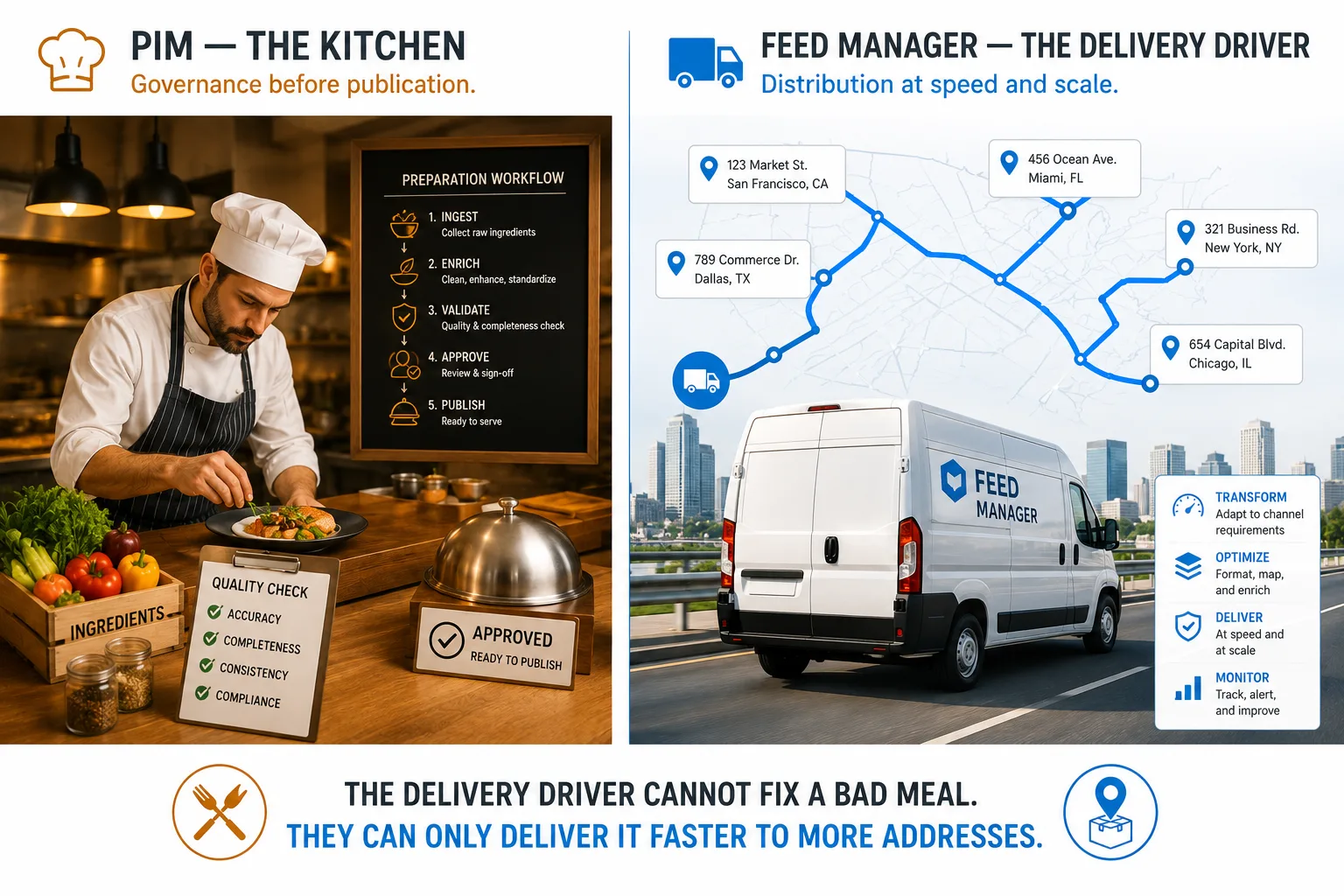
Retail executives generally agree on a strict implementation hierarchy: start with the PIM, then add a feed manager only if your channel management complexity demands it. Feeding messy, incomplete product descriptions into a high-speed distribution tool just means you publish bad data faster.
The analogy that makes this viscerally clear: your PIM is the kitchen. Your feed manager is the delivery driver. The delivery driver cannot fix a bad meal. They can only deliver it faster to more addresses.
This is the foundational principle that shapes every decision in this guide.
See how FeedOn.ai's AI-powered feed enrichment bridges the gap between messy source data and channel-ready product feeds
The Definitive 3-Year TCO Comparison — PIM + Feed Manager vs. PIM Alone vs. Feed Tool Alone
This is the most important section for any buyer making a real investment decision. Let's put the actual numbers side by side.
Understanding What Goes Into PIM TCO
Total Cost of Ownership for a PIM system is every cost associated with buying, running, and scaling product information management software over its full lifecycle. TCO goes far beyond the annual subscription. UK-based enterprise PIM implementations typically involve five cost categories: license fees (£15,000 to £100,000+/yr), data migration (£5,000 to £25,000 depending on source system complexity), integration with existing systems like ERP and e-commerce platforms (£5,000 to £30,000 per connection for legacy PIM; significantly less for API-first platforms), onboarding and training (10 to 15% of first-year spend), and ongoing operational costs (enrichment, translations, and quality management). At enterprise scale, implementation costs are typically equal to or greater than the first year of license fees. This is the most commonly missed cost in PIM evaluations — the implementation invoice arrives after you've signed the contract.
PIM Pricing by Business Size
Three variables determine fit more than anything else: SKU count, team size, and channel complexity. With under 5,000 SKUs and a small team, an entry-level SaaS plan is a reasonable starting point. Between 5,000 and 50,000 SKUs, the subscription price matters less than understanding the full year-one cost once implementation, integrations, and onboarding are factored in. At enterprise scale, the total cost of ownership over three to five years is a more useful number than the annual license fee.
PIM pricing benchmarks (2026):
Entry-level SaaS PIM plans start around $450/month, while mid-market configurations generally run $1,000 to $2,000/month. Enterprise-grade SaaS contracts move into custom pricing territory, often $25,000 to $90,000+ per year. Akeneo's Growth Edition starts at $25,000 per year. Pimcore Enterprise Edition is publicly listed at $29,900 per year as of June 2026. Plytix, designed for SMBs, offers a free tier and paid plans starting around €450 (approximately $485) per month.
The 3-Year TCO Comparison Model
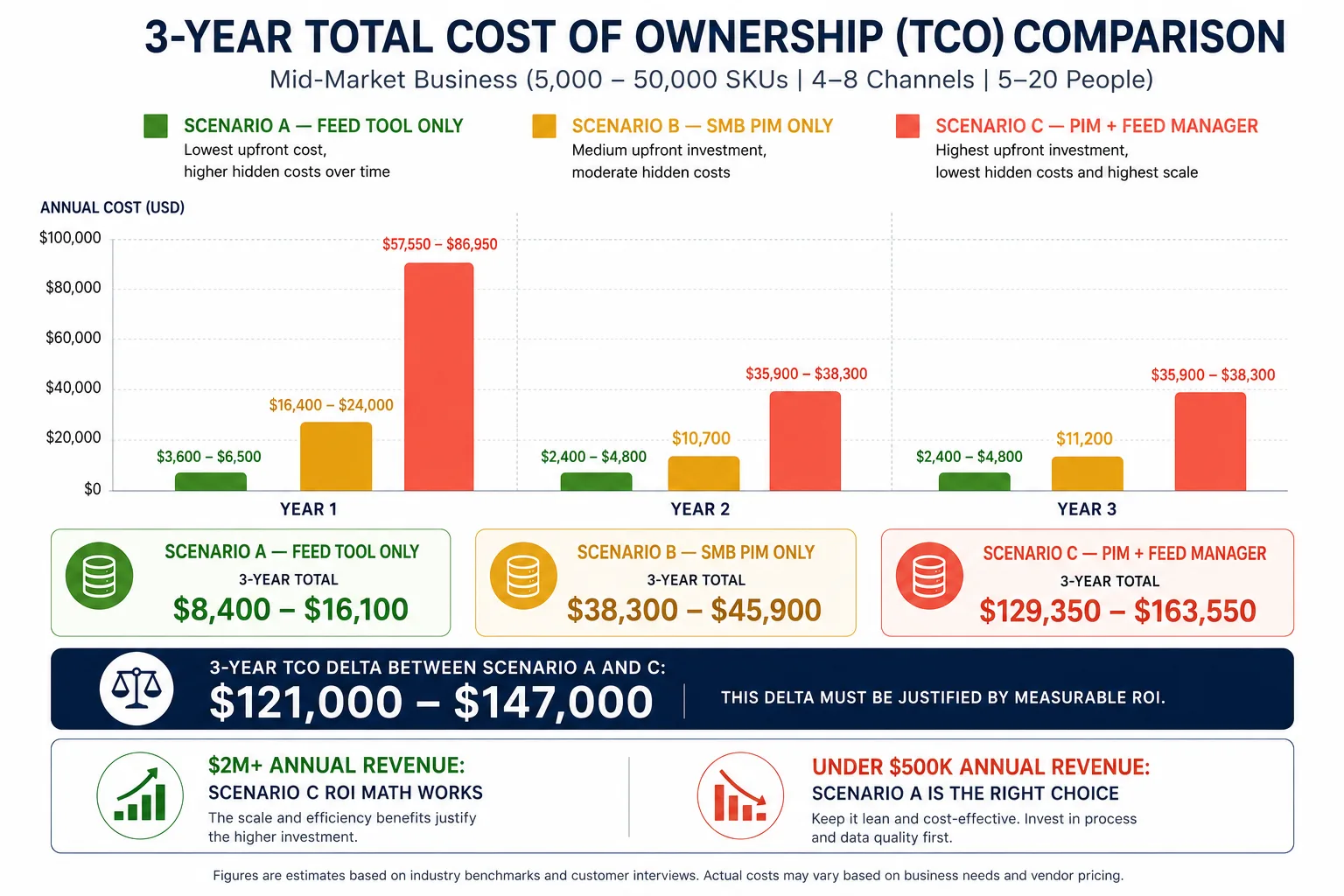
Here is the model no competing guide has built. Inputs are for a mid-market merchant with 8,000 SKUs, 4 channels, and a team of 5 people managing product data.
What These Numbers Mean
The 3-year TCO delta between Scenario A and Scenario C is $121,000–$147,000.
That delta needs to be justified by measurable ROI from the PIM investment. Here's how to evaluate that:
Most companies reach break-even within 6 to 18 months. PIM ROI comes from two sources: quantitative gains (labor savings, lower return rates, faster time to market, and higher conversion) and qualitative gains (brand consistency, data governance, and channel readiness).
If your 8,000-SKU business is generating $2M+ in annual e-commerce revenue, the ROI math from a PIM investment can work. If your annual e-commerce revenue is under $500K, the Scenario C TCO is disproportionate, and Scenario A is likely the right choice.
The right platform is not the cheapest one. It is the one whose total cost of ownership over three to five years is the lowest for your specific scale, technical requirements, and integration complexity.
Start with FeedOn.ai's AI-powered feed management — the no-setup-cost path to channel-ready product data for businesses that aren't ready for a six-figure PIM investment
The Decision Matrix — Which Tool Do You Need at Every Growth Stage?
No guide provides concrete thresholds. Every guide either says "you need both" (written by a PIM vendor) or "feed tools are enough" (written by a feed tool vendor). Here is the vendor-bias-free framework.
The Five Growth Stages: Exact Thresholds and Recommendations
Startup / Early DTC (Under 500 SKUs, 1–2 Channels, 1–2 People)
Stack recommendation: Feed management tool only.
At this stage, your product data fits in a well-organized Shopify store or spreadsheet. Your channel count is low enough that manual channel management is viable, and the ROI of a PIM investment doesn't materialize until you're dealing with the data governance problems that volume creates.
The specific pain points that trigger a move up to Stage 2 (instead of PIM investment at Stage 1):
You're spending more than 4 hours/week manually updating product data across channels
You've had your first feed rejection for missing or inconsistent attributes
You're launching on a second or third channel and data formatting differences are causing errors
Feed tool features needed at Stage 1: Basic channel publishing, auto-updating availability and price, and AI title enrichment for channel optimization.
Growth SMB (500–5,000 SKUs, 2–4 Channels, 2–5 People)
Stack recommendation: Feed management tool first, evaluate PIM at the upper end of this range.
This is the most common stage where merchants evaluate PIM prematurely. With under 5,000 SKUs and a small team, an entry-level SaaS plan is a reasonable starting point.
The specific triggers that indicate you're ready for PIM at Stage 2:
Multiple people are editing product data and creating conflicting versions
Your descriptions on your website no longer match your ad channel descriptions
You're spending >20% of a full-time employee's time on data entry, correction, and reconciliation
You're selling in multiple languages or regions with different attribute requirements
If these triggers aren't present: stay with a feed tool only.
Mid-Market (5,000–50,000 SKUs, 4–8 Channels, 5–20 People)
Stack recommendation: SMB PIM + dedicated feed manager. The combination becomes justified.
Between 5,000 and 50,000 SKUs, the subscription price matters less than understanding the full year-one cost once implementation, integrations, and onboarding are factored in.
At this stage, you have too many SKUs to govern manually, too many people touching product data to maintain consistency without a structured system, and enough channel complexity that feed tool sophistication matters. The PIM handles governance; the feed manager handles distribution agility.

The specific triggers that confirm you're at Stage 3:
You're launching in a new country/language at least once per year
You have a merchandising team, a marketing team, and an ecommerce team all with product data responsibilities
Your channel rejection rate is above 8% and the rejections are caused by data quality issues
You're adding more than 500 new SKUs per quarter with full attribute enrichment requirements
Enterprise (50,000–500,000 SKUs, 8+ Channels, 20+ People)
Stack recommendation: Enterprise PIM + dedicated feed manager. Both are non-negotiable.
Enterprise PIM is almost always custom-quoted, with annual contract values typically ranging from $25,000 to $90,000+. At this scale, implementation alone can cost as much as the software itself in year one, and multi-region operations or complex product data requirements push that figure higher.
At enterprise scale, the feed manager's role shifts from "channel distribution" to "channel API orchestration" — managing real-time sync, rate limit handling, supplemental feed logic, and channel-specific rule sets that are too complex and too numerous to maintain in a PIM's basic export functionality.
Global Enterprise (500,000+ SKUs, 10+ Markets, 50+ People)
Stack recommendation: Enterprise PIM + enterprise feed management platform + iPaaS integration layer + custom monitoring stack.
In 2026, enterprise buyers expect three things from any PIM on their shortlist: composable architecture. The PIM must connect to your existing commerce platform, ERP, DAM, and marketplace feeds through API endpoints.
At global enterprise scale, the PIM is one node-commerce team,e in a larger composable architecture (covered in Gap 8 below), not a standalone system. The feed manager similarly operates as a microservice within an event-driven architecture, not a scheduled batch tool.
See how FeedOn.ai fits into every growth stage — from a 200-SKU Shopify store to a 500,000-SKU enterprise feed operation
The PIM + Feed Manager Integration Architecture Blueprint
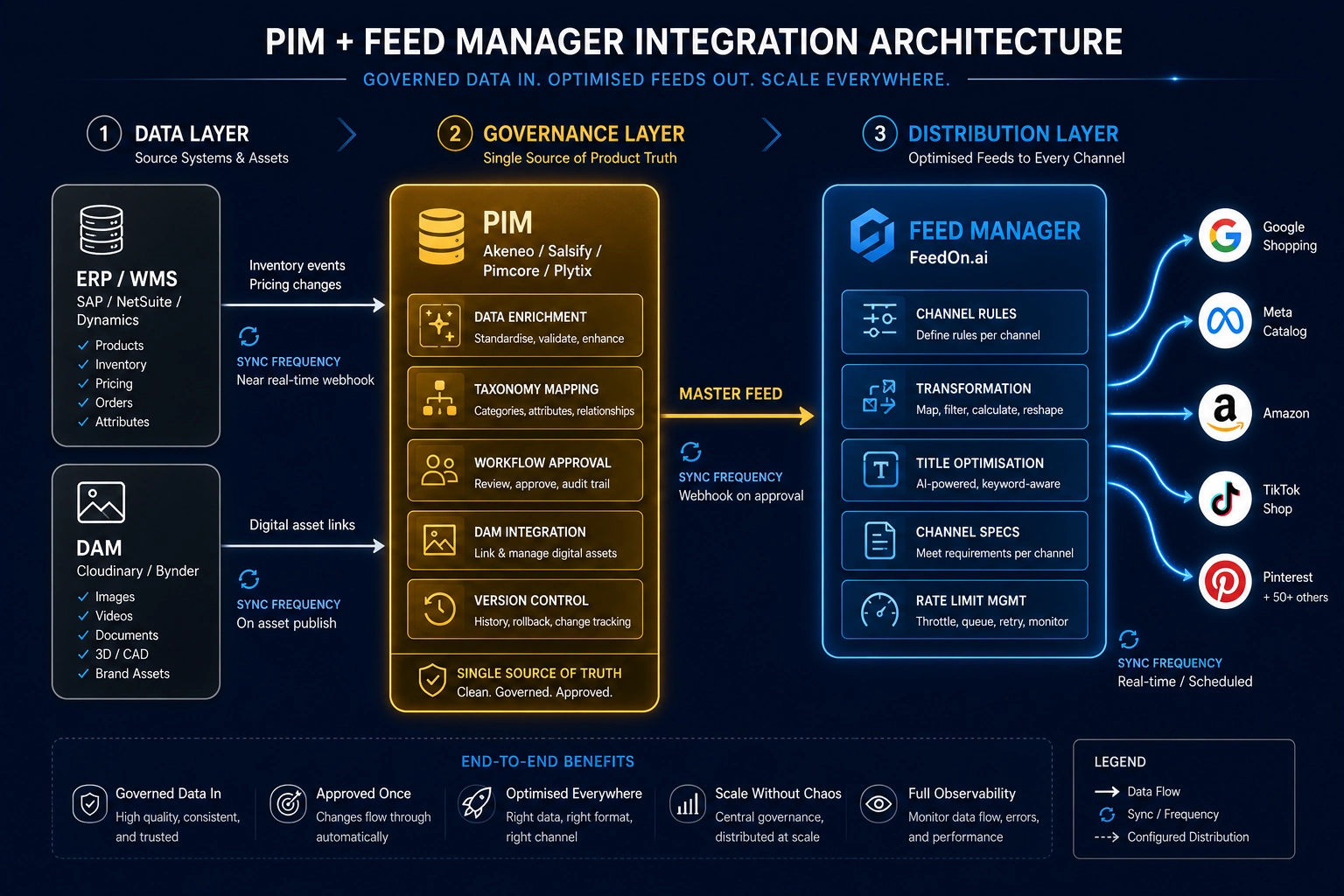
This is the first definitive technical diagram showing how data actually flows from ERP through PIM through feed manager to channels. No competing guide has built this.
The Complete Integration Architecture
The Four Integration Patterns
The method by which your PIM connects to your feed manager determines sync latency and operational complexity. Here are the four available patterns ranked from most to least recommended:
Webhook-Triggered Export (Recommended)
When a product is approved/published in your PIM, the PIM fires a webhook to your feed manager's API with the updated product data. The feed manager processes the update and pushes it to channel outputs immediately.
Latency: 1–5 minutes from PIM publish to channel update Setup complexity: Low — configure in PIM's webhook settings Best for: Shopify + any SaaS PIM with webhook support
PIM-Native Feed Export API
Your feed manager polls your PIM's product export API at a scheduled interval (e.g., every 60 minutes) for products updated since the last poll.
Latency: Up to 60 minutes from PIM update to channel update Setup complexity: Low-Medium — requires PIM API credentials and endpoint configuration Best for: PIMs without native webhook support (some legacy platforms)
Middleware / iPaaS Layer (e.g., MuleSoft, Boomi, Zapier for simpler setups)
A middleware platform mediates between PIM and feed manager, handling data transformation, error logging, and retry logic.
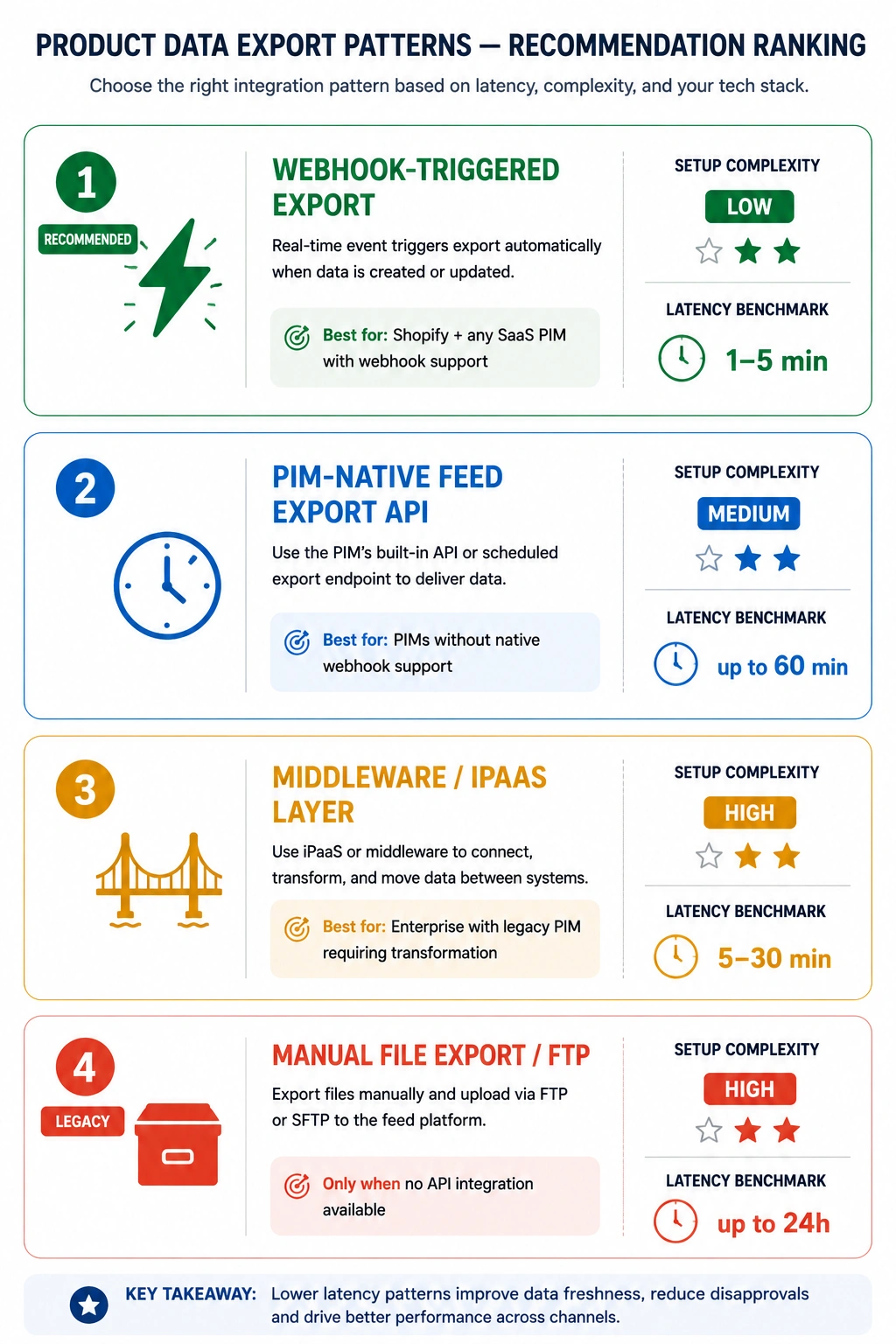
Latency: 5–30 minutes depending on iPaaS polling frequency Setup complexity: High — requires iPaaS configuration, field mapping, error handling Best for: Enterprise stacks with legacy PIM that requires data transformation before reaching the feed manager
Manual File Export / FTP (Legacy)
PIM generates a CSV/XML export file on a schedule; the feed manager reads from a shared FTP location.
Latency: Up to 24 hours Setup complexity: Low for setup; high for operations (manual oversight required) Best for: Only when no API integration is available; transition architecture while upgrading systems
The Sync Frequency by Data Layer
Different data elements need different sync frequencies between PIM and feed manager:

The Data Ownership Boundary (Pre-empting Data Drift)
The most operationally dangerous scenario in a PIM + feed manager stack is when the same field is editable in both systems. This creates "data drift" where your website shows different information than your ad channels.
The rule is absolute: product attributes are owned by the PIM, not the feed manager. The feed manager's job is transformation and distribution, not storage or enrichment.
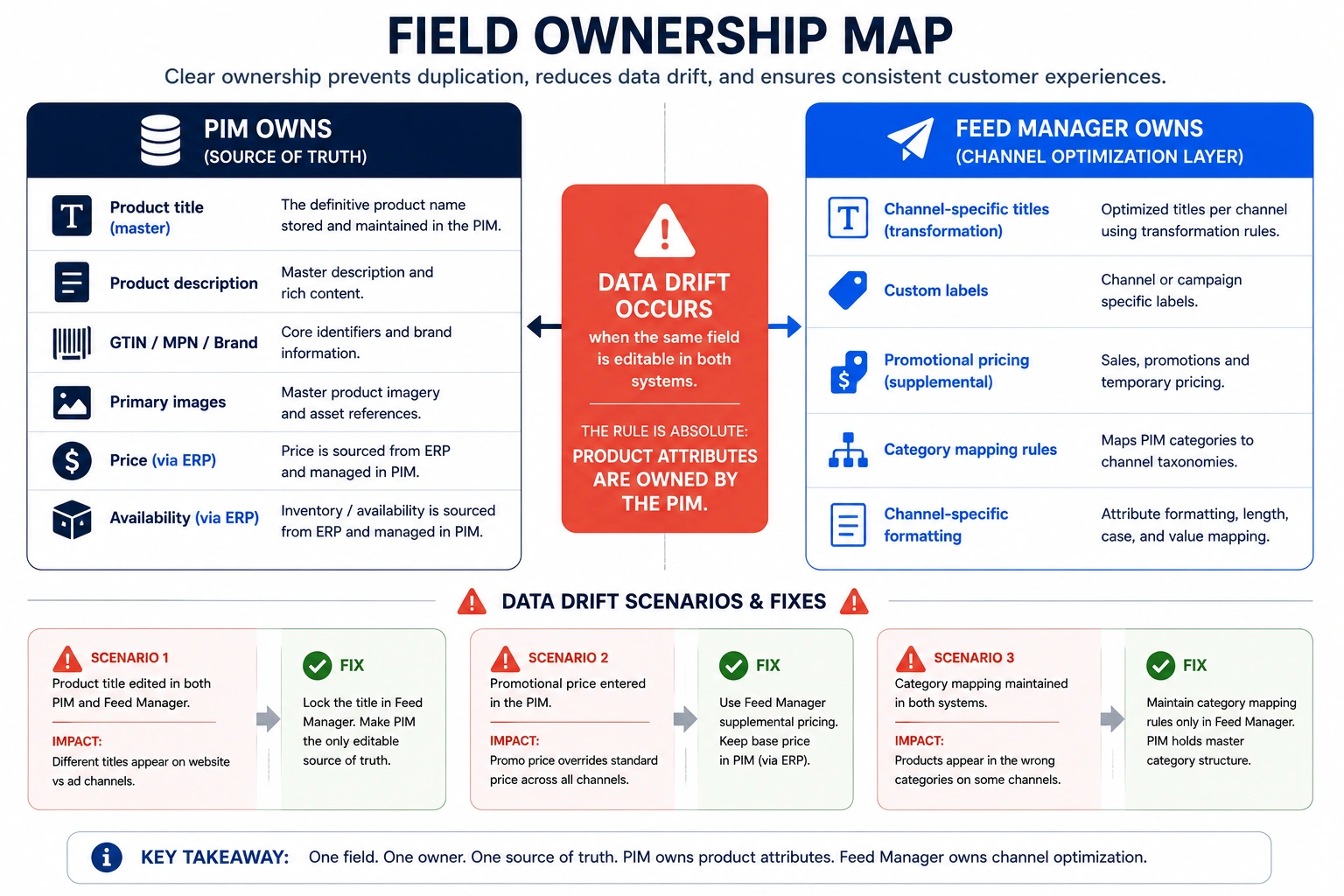
The permitted exception: channel-specific formatting rules (e.g., title front-loading logic, category mapping to a specific channel's taxonomy, and custom labels for campaign segmentation) can be managed in the feed manager without creating data drift because these rules produce channel-specific outputs from the master PIM data they don't modify the master data itself.
FeedOn.ai connects directly to your PIM, Shopify, or any data source via feed URL, API, or direct integration — maintaining a clean separation between source data and channel outputs
The PIM × Feed Manager Compatibility Matrix
Which PIM-to-feed-manager pairings have native connectors?
Which needs an iPaaS layer?
Which require custom API development?
Here is the honest compatibility landscape:
Native Connector Pairings (Build, Don't Bridge)

iPaaS-Required Pairings (Need Middleware)

Custom API Build Required
Scenarios where neither native connectors nor iPaaS is sufficient:
Legacy on-premise PIMs with no REST API (file export only)
Custom-built internal product databases with proprietary data schemas
Headless/composable setups with custom event buses
Ask whether the PIM is genuinely API-first and cloud-native, or whether it has been retrofitted with APIs on top of a legacy core. The answer to that question tells you whether you need custom development or can use native connectors. Look at how many public API endpoints the vendor offers and whether those APIs are included in your license or charged separately. Some vendors — like Bluestone PIM — offer 700+ public API endpoints with no usage fees. Others charge per API call or per connector, which compounds significantly over three years.
How AI Is Blurring the Line Between PIM and Feed Management and Where It Isn't
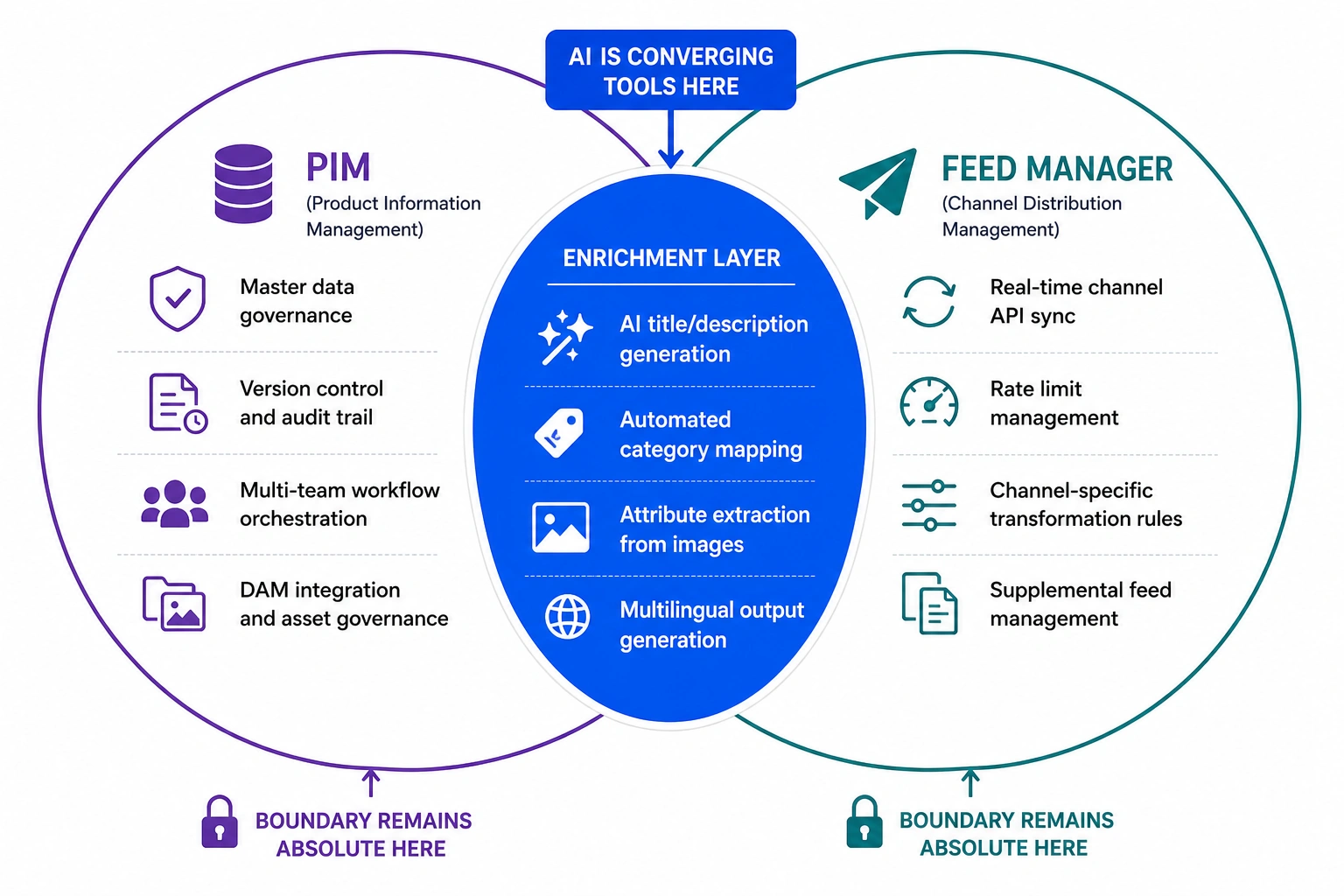
This is the most strategically important section for buyers evaluating both categories in 2026. AI is causing functional convergence at the edges of both tools, but the core distinction remains intact.
Where AI Is Blurring the Boundary
AI stands at the forefront of modern PIM innovation. Today's platforms increasingly use machine learning to automate enrichment, flag quality issues, suggest channel-specific metadata, and optimize digital assets. AI-driven PIM helps teams reduce manual effort, deliver personalized experiences, and smoothly scale catalog complexity.
Simultaneously, modern feed management tools like FeedOn.ai are deploying AI that generates missing attributes, rewrites titles for specific channel contexts, extracts color and size from product images, and creates multi-language outputs—all from within the feed tool itself, without the product data ever touching a PIM.
Functions that were traditionally PIM territory but are now available in advanced feed tools:
AI-powered title and description generation: PIM traditionally owned content creation. AI-native feed tools now generate channel-specific titles from product images and existing data — skipping the PIM enrichment stage entirely for basic attribute completion.
Automated category mapping: Taxonomy categorization was a PIM workflow. AI feed tools now auto-map products to Google Product Category, TikTok Shop categories, and Amazon browse nodes from product data alone.
Missing attribute extraction from images: PIM traditionally required manual attribute entry. AI vision technology in feed tools now extracts color, size, material, and style attributes from product images—filling gaps at the distribution layer without returning to the source system.
Multilingual output generation: PIM handled localization through workflow-managed translation processes. AI feed tools now generate translated channel outputs in 23+ languages from a single master feed.
Where the Boundary Remains Absolute
Despite the AI convergence at the edges, three PIM functions have no equivalent in any feed management tool:
1. Master data governance and version control
A feed tool's AI can generate a better title for Google Shopping. It cannot maintain a version-controlled master record of every product attribute change, with workflow approval, audit trail, and role-based edit permissions. That governance layer is what PIM exists to provide—and AI-in-feed tools don't replicate it.
2. Multi-team workflow orchestration
PIM manages the process by which product data moves from supplier to product manager to copywriter to translator to QA to publication. Feed tools receive data after that process is complete. They don't host it.
3. DAM integration and asset governance
PIM systems connect to Digital Asset Management (DAM) systems to manage the relationship between product records and digital assets (images, videos, PDFs, and spec sheets). Feed tools receive the final asset URLs; they don't manage asset governance, rights management, or asset versioning.
The Convergence Verdict
In 2026, Sales Layer is building AI into the way teams manage product information, not just into isolated content tasks. Its AI Hub helps teams translate content, improve product texts, complete empty fields, detect errors, and enrich product data across large catalogs.
This is what strategic convergence looks like in practice: PIMs are absorbing feed-management-adjacent AI functions (channel-specific content optimization, taxonomy automation), while feed tools are absorbing PIM-adjacent AI functions (attribute enrichment, multilingual output). The tools are converging at the enrichment layer while remaining distinct at the governance layer (PIM) and distribution layer (feed tools).
The practical implication: For businesses under 5,000 SKUs without complex governance requirements, an AI-native feed tool like FeedOn.ai can perform sufficient enrichment-layer functions to postpone or eliminate the PIM investment entirely. For businesses above 5,000 SKUs with multi-team data ownership, the PIM's governance layer becomes non-negotiable—and AI enrichment in the feed tool complements rather than replaces the PIM.
FeedOn.ai's AI enrichment generates titles, descriptions, attributes, and channel-specific outputs — functioning as a lightweight enrichment layer for businesses that don't yet need full PIM governance
The Data Governance Protocol — Preventing Data Drift When Running PIM + Feed Manager Together
This is the operational gap that every guide warns about, and none of them solve.
When a feed manager sits downstream of a PIM, there is an ever-present risk that a well-intentioned team member makes a "quick fix" in the feed tool's field transformation rules—creating a scenario where the data on your website no longer matches the data on your ad channels, and neither matches your PIM master record.
Here is the complete data governance SOP for preventing this.
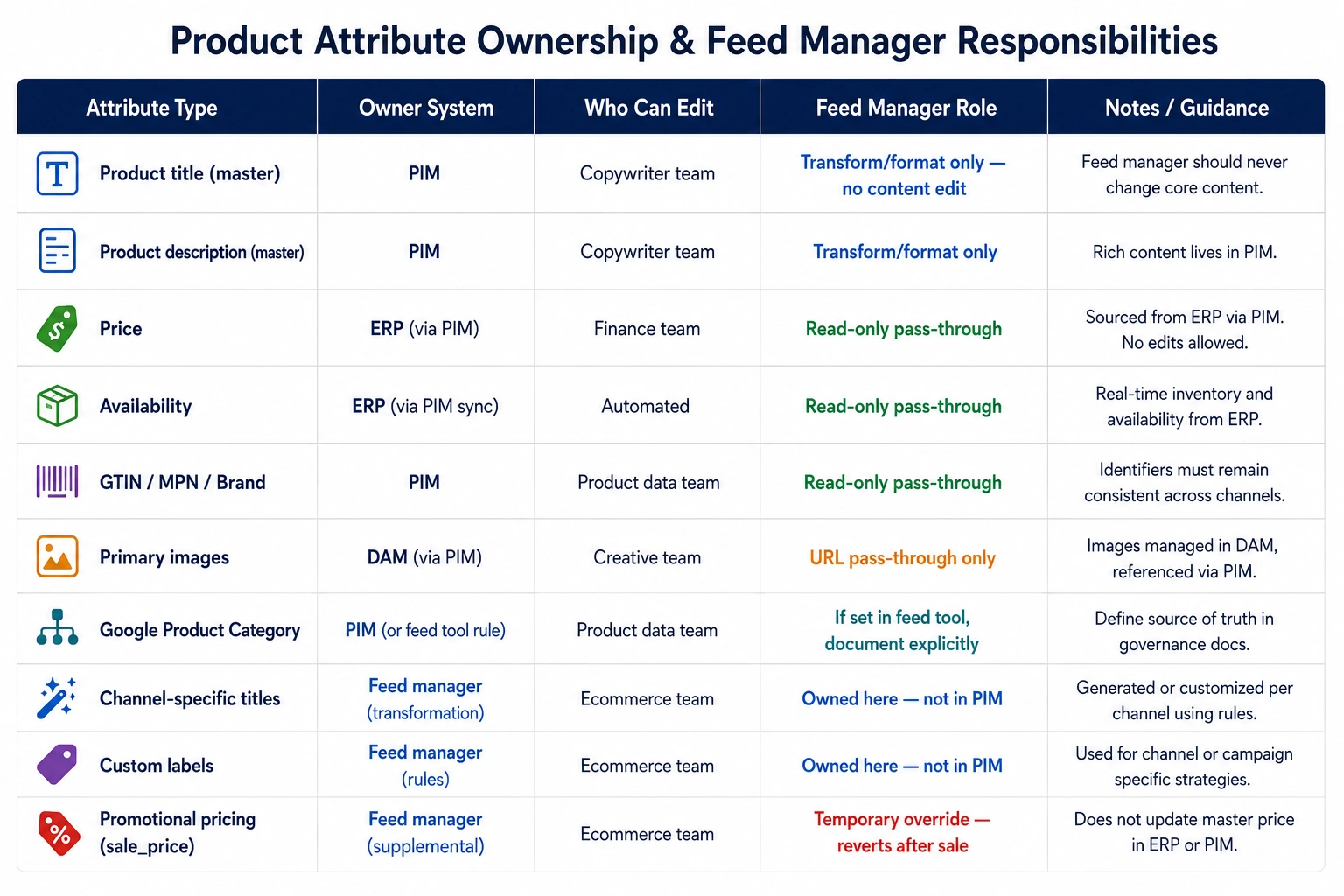
The Field Ownership Map
Every product attribute must have a single designated owner system. Document this before going live with PIM + feed manager:
The Three Data Drift Scenarios and Their Fixes
Title edited in feed tool instead of PIM
Symptom: Google Shopping shows a different title than your product page. Cause: A team member edited the title field directly in the feed tool UI instead of fixing it in the PIM. Fix: Implement role-based access control in the feed tool to make the title field read-only for all users. Only transformation rules (formatting and front-loading) are permitted—not direct value edits.
Price manually overridden in feed manager
Symptom: Ad channels show a different price than your website or PIM. Cause: A "temporary" price override was applied in the feed tool and not removed. Fix: Never apply price overrides in the feed manager. Route all pricing through the ERP → PIM → feed manager path. For promotional pricing, use supplemental feeds with sale_price_effective_date expiry — which auto-reverts without manual intervention.
Feed manager enrichment diverging from PIM master
Symptom: AI-generated descriptions in the feed differ from PIM descriptions. Cause: AI enrichment in the feed tool generates content that contradicts or differs from PIM-approved copy. Fix: Use AI enrichment in the feed tool only for fields not owned by the PIM (channel-specific titles, translated variants, short meta-descriptions). For PIM-owned fields, the feed tool should display the PIM value and not allow AI override.

The Reconciliation Audit Protocol
Run this audit monthly:
Sample 50 random SKUs from your live catalog
Compare three data points per SKU across three systems: PIM master record, live website product page, and live channel feed
Flag any divergence — even a $0.01 price difference or a single-word title discrepancy
Trace divergence to source: Is it a PIM approval workflow failure? A feed tool override? An ERP sync lag?
Document and resolve within 48 hours; update governance SOP if the same divergence type appears twice
PIM drastically reduces the time needed to update a product — sometimes halving or tripling it, depending on the initial level of complexity. There has also been a significant reduction in the number of errors detected after publication, thanks in particular to better-structured validation workflows and centralized data sources.
Those gains only materialize if data drift is actively prevented through the governance protocol above.
PIM vs. Feed Management for B2B — A Completely Different Calculus
Every ranking page frames the PIM-vs-feed-management discussion through a B2C/DTC lens: Google Shopping, Amazon, Meta ads, Shopify catalogs. For B2B merchants—manufacturers, distributors, and wholesalers—the calculus is fundamentally different.
Why B2B Changes the PIM Decision Entirely
Most PIM vendor shortlists are built for retailers. The evaluation criteria assume a few thousand SKUs, consistent brand-owned product data, and a single primary e-commerce channel. B2B distributors face a different set of problems: catalogues of 50,000 to 500,000 SKUs, product data arriving from hundreds of manufacturers in incompatible formats, an ERP that holds the authoritative stock and pricing record, and trade customers who need technical completeness rather than lifestyle imagery.
In B2B, the case for PIM arrives earlier — often at SKU counts where a B2C brand would still be comfortable in a spreadsheet — because the data complexity is qualitatively different, not just quantitatively different.
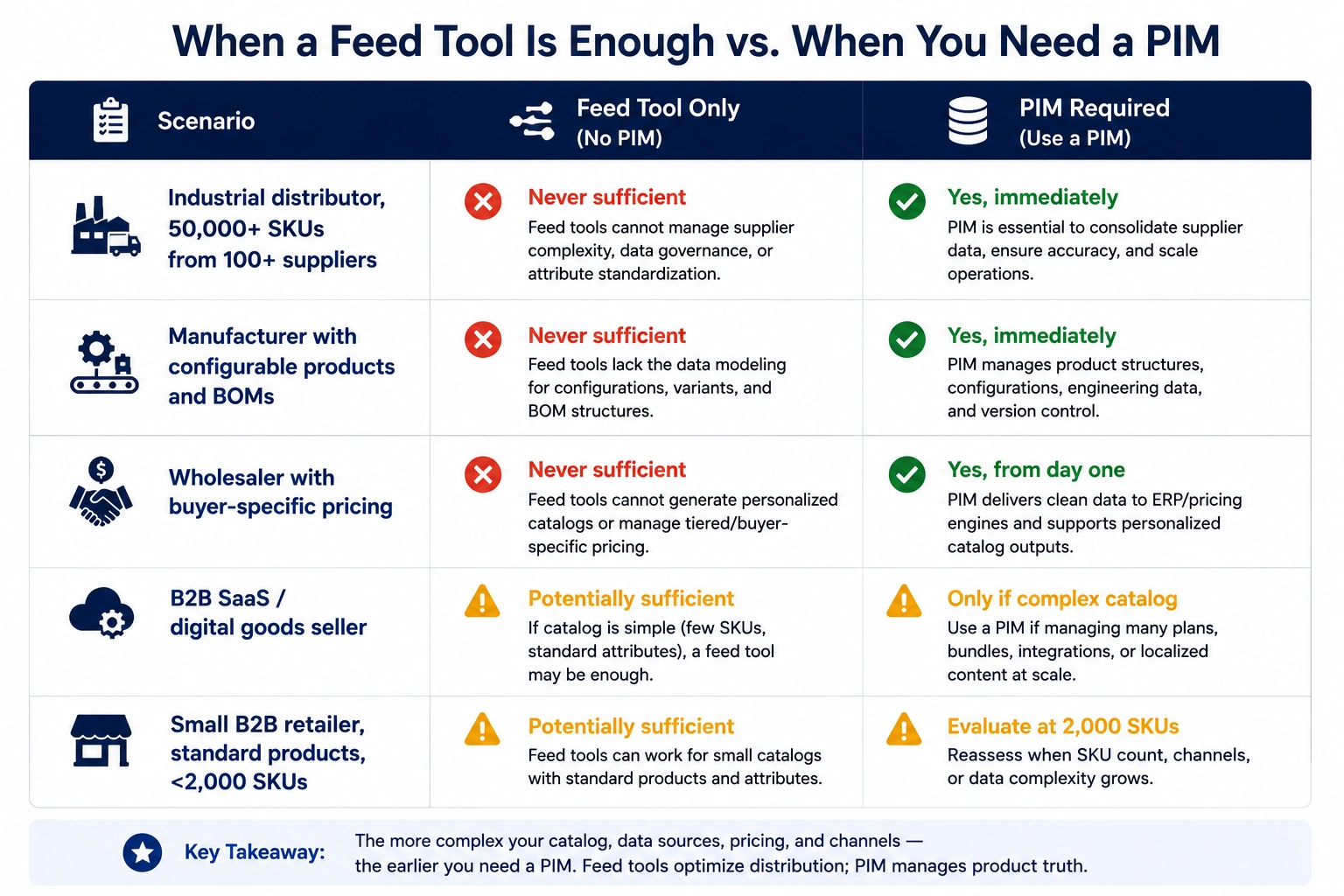
The Five B2B Scenarios Where PIM Becomes Non-Negotiable

Buyer-Specific Pricing
Pricing must be account-specific and flexible enough to support contract catalogs, tier pricing, negotiated terms, regional differences, and ERP-driven price logic.
Feed management tools are designed for a single price per product per market. B2B buyer-specific pricing where Buyer A sees $45, Buyer B sees $52, and Buyer C sees $38 for the same SKU requires a PIM connected to your ERP's customer pricing module. Feed tools cannot generate buyer-specific catalog outputs without a PIM as the intermediary.
Technical Specifications and Compliance Documentation
Manufacturing product data extends beyond basic descriptions and images. Technical specifications, compliance certifications, CAD files, installation guides, material safety data sheets, and compatibility matrices all influence buying decisions. PIM centralizes all product information in one system of record.
A feed management tool's field set is designed for retail channel attributes: title, description, price, availability, GTIN, and image. Technical documentation (CAD files, safety data sheets, compliance certifications, and bill of materials) has no equivalent in any feed management schema. Only PIM handles this category of product data — and for manufacturers, it's often the most commercially critical data they publish.
Complex Product Hierarchies and BOMs
PIM systems are designed to support complex product relationships and technical data requirements within manufacturing. They manage bill of materials relationships, product variants with different specifications, accessory and compatibility rules, and multi-language content for global markets.
A configurable industrial machine with 200 component variants across 12 sub-assemblies cannot be represented in a feed tool's variant architecture. Feed tools support item_group_id for color/size variants. They have no concept of BOM hierarchy, compatibility matrices, or parent-child-component product relationships.
Punchout Catalogs and EDI
The scenario is especially relevant for businesses with customer-specific pricing, large catalogs, quote-based transactions, multi-user accounts, and procurement integrations.
Punchout catalogs (CXML, OCI) and EDI integrations are entirely outside the scope of feed management tools. These are PIM territories—connecting your product data to enterprise procurement systems used by your B2B buyers.
AI Procurement Agents
In 2026, distributor e-commerce is also becoming an AI-readiness issue, since emerging procurement agents need clean, governed access to product, price, and availability data.
AI procurement agents — bots that research, compare, and purchase on behalf of enterprise buyers — need structured, governed, accurate product data that they can reliably query via API. A feed tool can't provide this: it's an outbound distribution system, not a governed product data API. The practical question is whether your catalog, pricing, and availability data are reachable, accurate, and trustworthy enough for those agents to recommend or transact against.
The B2B PIM Decision Threshold
For B2B merchants, compress the growth-stage thresholds significantly:
PIM for distributors is no longer a "nice to have." It is the single biggest growth lever in B2B distribution today.
That said, B2B businesses still need feed management tools for their retail channel presence — Google Shopping, Amazon Business, and marketplace listings. The B2B calculus isn't "PIM instead of feed tool." It's "PIM is required earlier, AND feed tool is still needed for channel distribution."
FeedOn.ai integrates with enterprise PIMs and handles the B2B channel distribution layer — Google Shopping, Amazon, and marketplace feeds — from your PIM's output
The Composable Commerce Stack Blueprint — Where PIM and Feed Management Fit in MACH Architecture
92% of US brands have implemented composable commerce, deployment is 80% faster, and conversion rates increase by an average of 42%. By 2026, the average tech stack is expected to be 61% MACH-based.
Understanding where PIM and feed management sit in a MACH composable stack is no longer a future-state question. It's an operational one.
The MACH Architecture Fundamentals
MACH architecture comprises microservices for independent deployment of functionalities, API-first design for seamless integration, cloud-native infrastructure for scalable and resilient operations, and headless systems for flexibility in front-end presentation.
In a MACH composable stack, each commerce function runs as an independent service. CMS, search, PIM, checkout, and payment are developed, deployed, and scaled independently — without mutual dependencies.
Where PIM Sits in MACH
A product information management system based on MACH architecture fits other best-of-breed solutions like headless CMS, ERP, or DAM and can work with them within a composable ecosystem. With its help, enterprises can create a future-proof, scalable, and open digital stack.
In MACH terminology, PIM is a Packaged Business Capability (PBC) — a pre-built, API-accessible service that handles a specific business domain (product information governance). Brands operating within the modern MACH architecture prefer composable commerce. They deploy an API-first PIM as the central hub, plugging it directly into specialized feed engines.
The Full MACH Stack Architecture Diagram
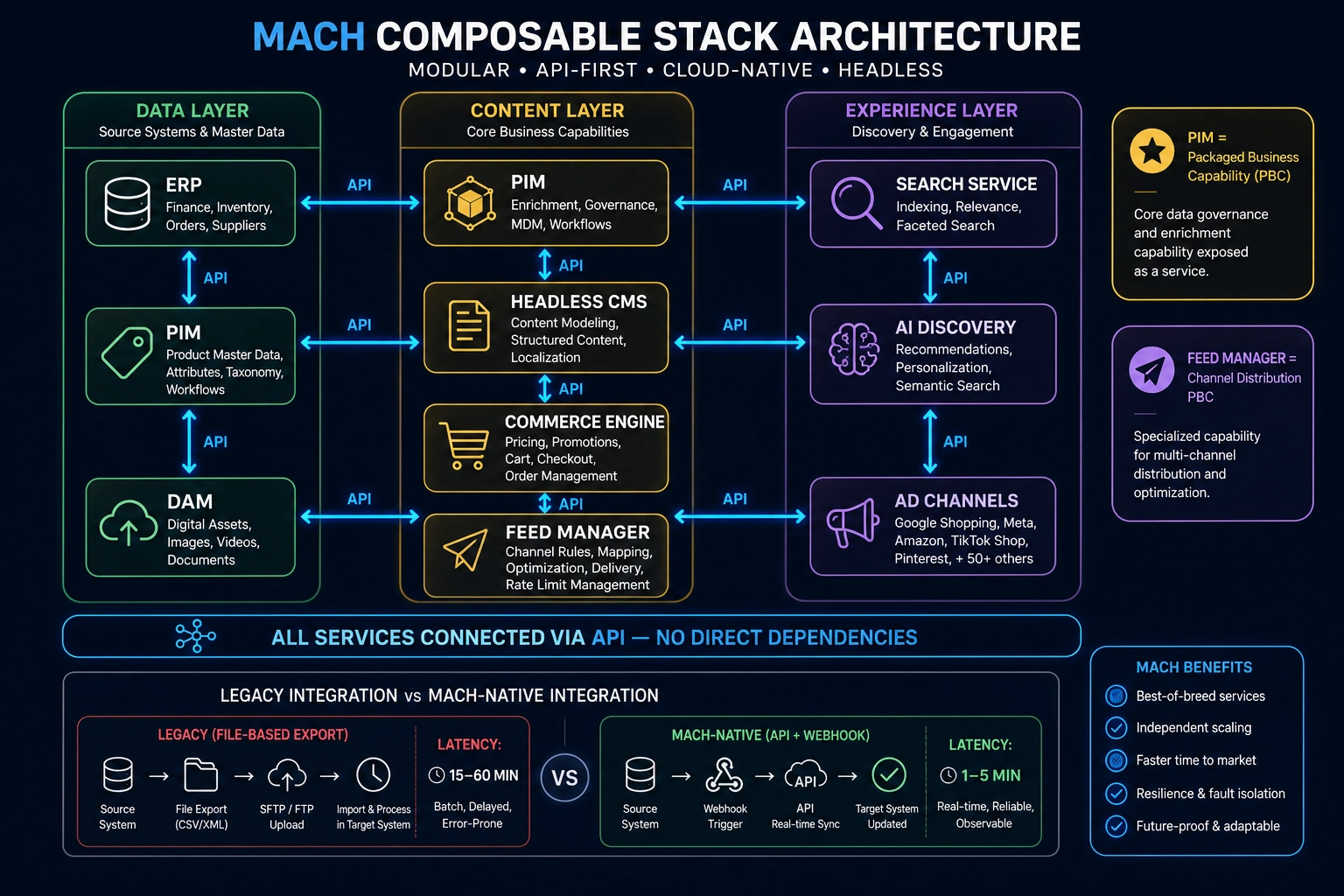
The Event-Driven Sync Pattern in MACH
In a MACH stack, designate one service (e.g., PIM for product data, OMS for inventory) as the System of Record for each data domain. Use asynchronous events to propagate changes, favoring eventual consistency over synchronous, low-performance calls.
The practical implementation:
ERP fires an inventory event → Published to message bus (e.g., AWS EventBridge)
PIM subscribes to inventory event → Updates product availability in master record
PIM fires product update event → Published to message bus
Feed Manager subscribes to product update event → Transforms and pushes to channel APIs
Channels reflect update → Within 1–10 minutes of original ERP inventory change
This architecture achieves the end-to-end latency target from our real-time feed guide: under 10 minutes from ERP event to channel reflection, with no single-point-of-failure bottleneck.
Legacy PIM vs. MACH-Native PIM: Why It Matters for Feed Integration
Legacy monolithic PIM solutions are convenient for IT and business teams. However, they are often built on a single code base. That means if they get larger over time, the scalability may become limited, and the time for updates and adding new features extended. MACH-based PIM offers unlimited scalability and agility, resulting from the implemented technology solutions.
The practical difference for feed management integration:
MACH-native PIM (Akeneo, Bluestone, Contentserv): Exposes REST/GraphQL APIs for all product data; webhook support for real-time feed sync; easy feed manager integration
Legacy PIM (older on-premise implementations): File-based export only; no real-time webhook; requires middleware for feed manager integration; adds 15–60 minutes to feed sync latency
Companies implementing MACH principles release new features 40% faster than with traditional systems. For feed management specifically, this means adding a new channel or modifying a channel-specific output rule takes hours, not weeks.
The Combined ROI Framework — Building the Business Case for PIM + Feed Manager Together
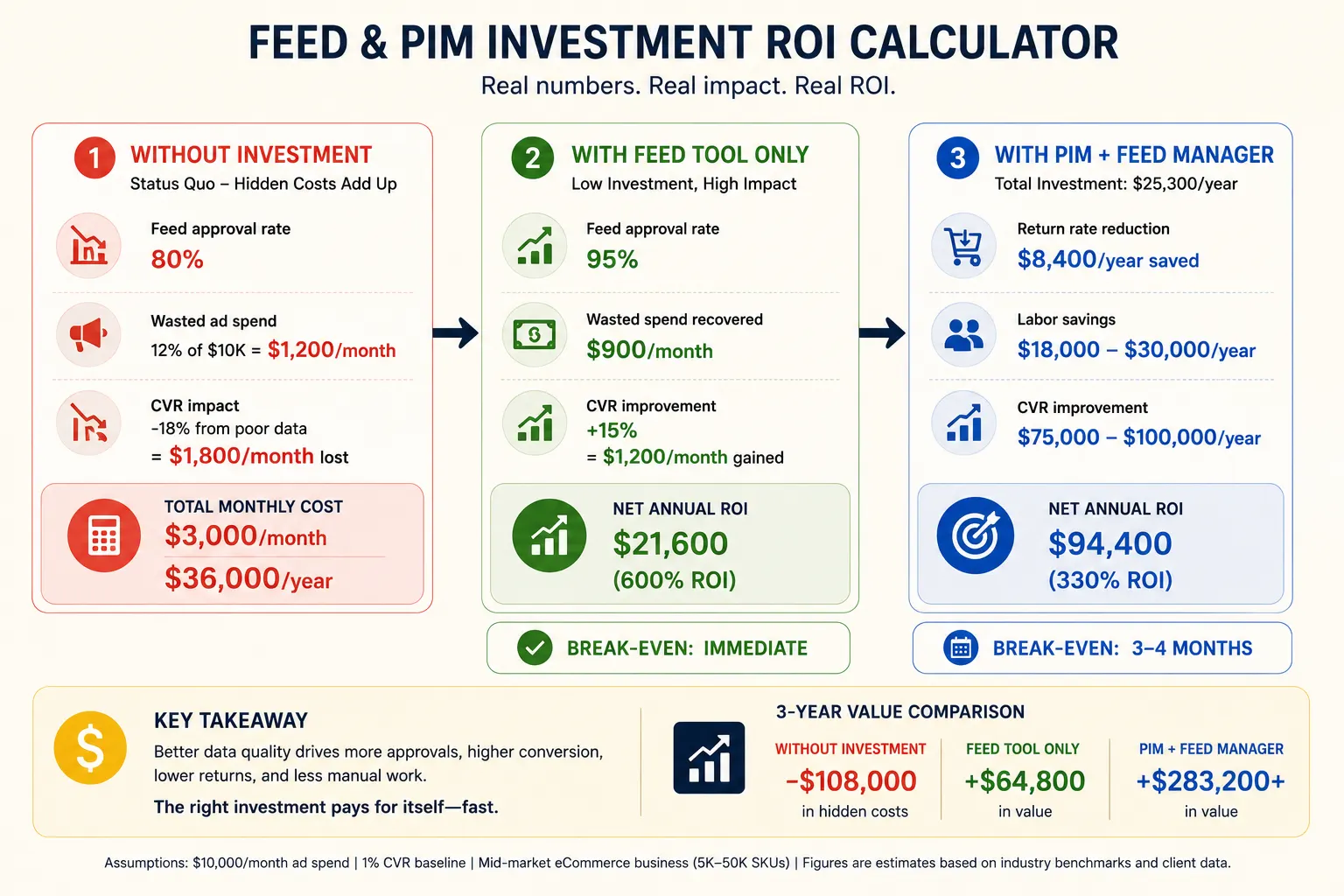
The single most requested thing in any PIM or feed management evaluation is a business case with real numbers. Here it is.
PIM-Only ROI Benchmarks
Quantitative returns show up directly in cost savings and revenue figures: fewer hours spent on manual product data enrichment, fewer product returns due to incorrect specifications, more revenue from products reaching market faster, and higher conversion from complete product content.
Published ROI benchmarks from PIM implementations:
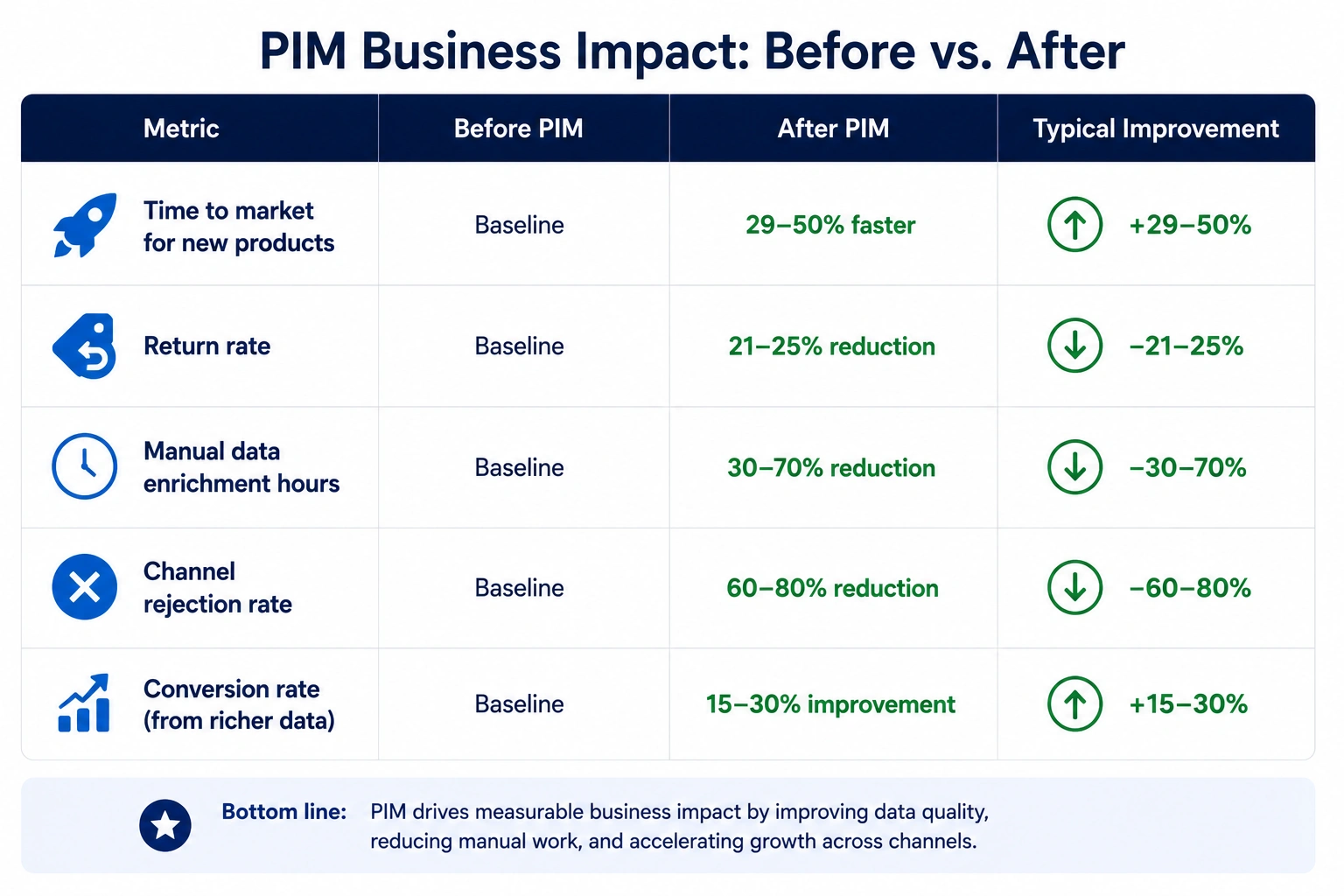
PIM drastically reduces the time needed to update a product — sometimes halving or tripling it, depending on the initial level of complexity.
Feed Management ROI Benchmarks
For dedicated feed management tool ROI, the primary financial drivers are:

The Combined ROI Model
For a business spending $10,000/month on Google Shopping, Meta, and Amazon Shopping Ads:
Without PIM or feed management:
Feed approval rate: ~80%
Wasted ad spend (disapproved + stale data): ~12% of $10K = $1,200/month
Missed conversions from poor product data: ~18% lower CVR than optimised = ~$1,800/month in lost revenue
Total monthly cost of no investment: ~$3,000/month = $36,000/year
With feed management only (FeedOn.ai at ~$300/month):
Feed approval rate: ~95%
Wasted ad spend: ~3% = $300/month
CVR improvement: ~+15% from AI-enriched data = ~$1,200/month in gained revenue
Net annual benefit: ($900 wasted spend recovered + $1,200 revenue gained) × 12 = $25,200/year
Less tool cost: $3,600/year
Net annual ROI: $21,600 (600%)
Adding PIM at mid-market scale (5,000+ SKUs, additional $25,000/year):
At this scale, PIM adds:
Time-to-market improvement: 30% faster → value depends on launch frequency
Return rate reduction: 21% reduction → on $500K annual revenue with 8% return rate = $8,400/year saved
Manual labor reduction: 30–50% on 2 FTEs managing product data → $18,000–$30,000/year in labor savings
Conversion rate improvement: +15–20% from richer data → on $500K revenue = $75,000–$100,000/year
Net annual ROI from combined PIM + feed manager:
Feed management ROI: $21,600
PIM ROI (conservative): $8,400 + $18,000 + $75,000 = $101,400
Total benefits: $123,000/year
Total tool costs: $28,600/year
Net annual ROI: $94,400 (330% ROI)
Most companies reach break-even within 6 to 18 months. The model above suggests break-even within 3–4 months at mid-market scale.
The Honest "Feed Tool Only" Assessment — When Skipping PIM Is the Right Call
Every ranking article is written by a PIM vendor. The implicit conclusion is always "You need PIM." Here is the genuinely honest counterargument.
The Scenarios Where Feed Tool Only Is the Right Call
Pure Dropship / Marketplace-Only Seller
You don't own the product data. Your supplier provides titles, descriptions, images, and attributes. You distribute them to marketplaces. PIM adds no value here—you're not enriching or governing data you don't own. Feed management is everything.
Single-Platform Shopify Store Under 2,000 SKUs
If your entire operation runs through Shopify, your Shopify admin already functions as a basic PIM—central product record, consistent data, and single source of truth. Adding a PIM to govern what Shopify already governs adds cost and complexity without proportional benefit. A feed management tool that connects to Shopify and distributes to shopping channels is sufficient.
Category-Focused Merchant With Simple, Stable Attributes
If you sell a single product category with simple, consistent attributes (e.g., print-on-demand products, candles, subscription boxes), your product data complexity doesn't justify PIM governance overhead. Feed management handles your channel distribution; your e-commerce platform handles your master record.
Startups Prioritising Speed Over Governance
A startup moving fast needs to launch channels, test product-market fit, and optimize. PIM implementation takes 3–6 months and requires organizational change management. Feed management tools deploy in days. If speed is the priority and governance debt is acceptable for 12–18 months, defer the PIM.
The Governance Debt Timeline (When Feed-Only Starts to Hurt)
If you choose the feed tool only and grow, here is when the governance debt becomes measurable:

The honest answer: with under 5,000 SKUs and a small team, an entry-level SaaS plan is a reasonable starting point. A feed management tool alone, with AI enrichment capabilities, is sufficient for the majority of e-commerce businesses operating below this threshold.
The caveat: begin your PIM evaluation at 3,000 SKUs, not 5,000. Implementation takes time. By the time you decide you need a PIM at 5,000 SKUs, you're already 3–6 months from going live. If you start evaluating at 3,000 SKUs, you arrive at the PIM at 5,000–6,000 SKUs before the governance debt becomes critical.
FeedOn.ai works as your complete feed management layer at every growth stage — from 200 SKUs to 500,000+ — and integrates with your PIM when you're ready to add governance
The Decision in One Sentence
If you're under 5,000 SKUs, operating on a single e-commerce platform, and your primary challenge is channel distribution and feed quality, a feed management tool with AI enrichment is your most cost-effective next step. If you're above 5,000 SKUs, managing multi-team data ownership, expanding internationally, or operating in B2B, PIM is non-negotiable, and a dedicated feed manager sitting downstream of it is how you protect the distribution layer.
Start your free FeedOn.ai plan 200 products and 3,000 AI credits. No credit card required. Whether you're running a feed-tool-only or connecting to an enterprise PIM, FeedOn.ai works at every layer of your stack.
FAQ
1. What is the difference between product feed management and PIM software?
Product feed management software optimizes and distributes product data to sales and advertising channels like Google Shopping, Meta, and TikTok Shop. A Product Information Management (PIM) system acts as the central source of truth for product information, storing and managing product data across the business. Feed management focuses on channel optimization, while PIM focuses on product data governance.
2. Do I need a PIM or a product feed management tool?
It depends on your business. If your main goal is optimizing product listings for marketplaces and ad channels, a feed management tool is usually sufficient. If you manage thousands of products from multiple suppliers with complex product data workflows, a PIM may be the better choice.
3. Can I use a product feed management tool without a PIM?
Yes. Many small and mid-sized ecommerce businesses successfully use a feed management tool without a PIM. Feed management software can pull data directly from ecommerce platforms like Shopify or WooCommerce and optimize it for multiple channels.
4. When should a business invest in a PIM system?
A PIM becomes valuable when you manage large product catalogs, multiple brands, multiple suppliers, multilingual content, or need strict control over product data across numerous sales channels and internal teams.
5. What are the benefits of product feed management software?
Product feed management software helps businesses:
Optimize product titles and descriptions
Enrich missing attributes
Sync inventory automatically
Reduce product disapprovals
Publish feeds to multiple channels
Improve Shopping campaign performance
Save time through automation.
6. Can a feed management tool improve Google Shopping performance?
Yes. By optimizing titles, attributes, categories, images, and availability, a feed management tool can improve product visibility, reduce Merchant Center errors, and increase click-through rates and return on ad spend (ROAS).
7. Is PIM software necessary for small ecommerce businesses?
Not always. Many small businesses can effectively manage their product catalog using their ecommerce platform together with a dedicated feed management solution. A PIM often becomes necessary as product complexity and operational requirements increase.