
Product Feed for Affiliate Marketing: The Complete 2026 Guide
Most guides about product feeds for affiliate marketing answer the same basic question: what is a product feed and why do you need one? The answer is always the same. You need structured product data so affiliates can promote your catalog accurately.
That is where every guide stops.
What happens when you already understand the basics? What do you do when you want to know how your Google Shopping feed differs from an AWIN feed, how a cashback site uses your data differently from a content blogger, or why your affiliate program is quietly losing partners because your feed is 48 hours stale?
This guide answers all of that. We cover the structural differences between feed types, the specific requirements of every major affiliate network, how to optimize your feed for four completely different types of affiliates, how AI is changing what is possible, and how to measure whether your feed is actually working.
What a product feed actually does in affiliate marketing
A product feed in affiliate marketing is a structured data file that you as a merchant provide to your affiliate partners. It contains your full product catalog or a curated subset of it, with all the information affiliates need to promote your products accurately and compliantly.
A typical affiliate product feed includes your product title, description, image URL, deep link to the product page with tracking parameters, price, sale price, availability, brand, category, GTIN or MPN, and any promotional codes or cashback rates associated with each item.
The feed gives affiliates a live, always current view of what you sell and what it costs. Rather than writing product descriptions from scratch, manually checking whether something is in stock, or screenshotting product images, an affiliate can pull your feed directly into their website, comparison engine, or cashback platform and have accurate data refreshed automatically.
This sounds simple. In practice, most merchant feeds are incomplete, stale, poorly structured, or formatted for Google Shopping rather than the affiliate channels they are meant to serve. Those problems quietly destroy affiliate program performance.
Understanding the feed from both sides, from the merchant building it and the affiliate consuming it, is the starting point for getting this right. If you want to understand how AI is changing the broader landscape of product feed management in 2026, that context is worth reading before you dive into the affiliate specifics.
Google Shopping feed vs affiliate network feed: what changes, what transfers
This is the question most merchants never ask, and it costs them weeks of troubleshooting when they try to submit their Google Shopping feed to an affiliate network and get errors.

What is the same
Both feed types share a common data core. Product title, description, price, availability, image URL, product category, brand, and product identifiers like GTIN and MPN are required or recommended in both contexts. If your Google Shopping feed is well optimized with clean titles, complete attributes, and accurate pricing, that data foundation serves you well in affiliate channels too. Work on optimizing your Google Shopping feed first. Everything else builds on top of it.
What changes for affiliate networks
The differences are structural, and they matter.
Deep links with tracking parameters. In Google Shopping your product URL points directly to your product page. In affiliate feeds, every URL must include the network tracking parameters that attribute a click and subsequent sale to the correct affiliate partner. A Google Shopping feed submitted to AWIN without tracking parameters built into the product URLs will fail to attribute any sales, meaning affiliates who drive real traffic earn nothing. That ends the relationship.
Promotional data fields. Affiliate networks use additional fields that Google Shopping does not require: promotion_id for active voucher codes, promotion_description for what the offer is, and promotion_expiry so affiliates know when to stop promoting a deal. Cashback and coupon affiliates depend on these fields to build campaigns. Without them, those affiliates cannot work with your catalog effectively.
Category taxonomy. Google Shopping uses Google's Product Taxonomy, a specific numeric category ID system. Most affiliate networks use their own category structures. AWIN uses its own category tree. ShareASale has a different one. CJ uses yet another. Submitting Google category IDs to an affiliate network typically either fails validation or results in incorrect categorization that affects how affiliates browse your catalog.
Image specifications. Google Shopping requires a minimum 100 x 100 pixel image, with 250 x 250 recommended for apparel. Affiliate networks for content creators often want higher resolution lifestyle images rather than plain white background shots. The image that performs best in Google Shopping is not always the image that drives the most affiliate clicks on a fashion blog.
Feed format and delivery method. Google Merchant Center accepts XML, CSV, and TSV via URL, SFTP, or manual upload. Affiliate networks each have their preferred formats and submission methods. AWIN historically preferred CSV. Some CJ integrations use an API. Knowing which format each network accepts before you start saves significant time.
The practical implication
You cannot simply reuse your Google Shopping feed unchanged for affiliate marketing. You need channel-specific transformations applied from a single master product catalog, not a separate manual rebuild of your feed for each destination. This is exactly what FeedOn's multichannel publishing is built to do: one clean source, correctly formatted outputs for every channel, including affiliate networks.
Network by network: AWIN, CJ, ShareASale, Rakuten, and Impact feed requirements compared
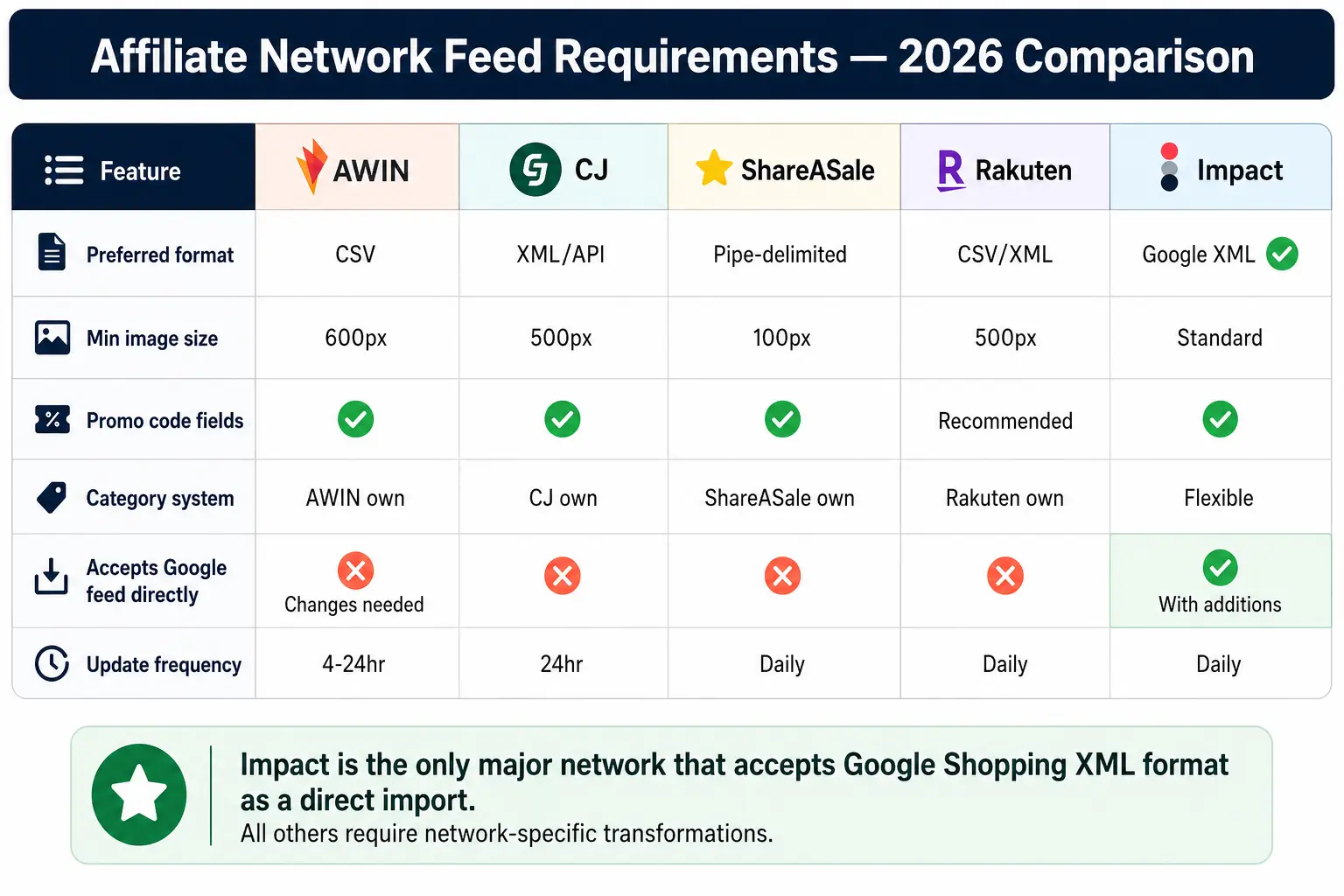
This reference does not exist anywhere in this SERP. Here it is.
AWIN
AWIN is the largest affiliate network in Europe and a major presence globally. Feed submission on AWIN is done through their merchant interface, where you provide a feed URL that AWIN fetches on a schedule you set.
Required fields: product ID, product name, description, landing page URL with tracking parameters, image URL, price, availability, category (AWIN taxonomy, not Google), and brand.
Recommended fields: sale price, sale price effective date, GTIN, MPN, product type, additional image URLs.
Image specifications: Minimum 600 x 600 pixels. AWIN recommends 1000 x 1000 pixels for publisher display quality. A white background for product shots is preferred, but lifestyle images in additional image fields are encouraged.
Format: CSV is the most widely used. AWIN also accepts XML.
Update frequency requirement: AWIN recommends a minimum daily refresh. For sale items and promotional products, they recommend 4 to 6 hour refresh cycles during active promotions.
Deep link format: Your product URLs must include AWIN's awc or awinmid tracking parameters appended. AWIN provides documentation for the exact URL structure required.
Key note for UK and EU merchants: AWIN requires the price to be inclusive of VAT for markets where VAT applies.
CJ Affiliate (Commission Junction)
CJ is the largest affiliate network in North America and runs its own distinct feed infrastructure.
Required fields: advertiser ID, catalog ID, product ID (SKU), product name, description, buy URL with tracking, image URL, price, currency, and in-stock indicator.
Recommended fields: sale price, sale price effective date, keywords, category, brand, GTIN, manufacturer part number.
Image specifications: CJ recommends at least 500 x 500 pixels. Larger images improve publisher placement quality. No promotional text overlays permitted.
Format: CJ uses its own XML feed schema. Their Affiliate Web Services API is the preferred modern integration method for larger catalogs. CSV upload is available for smaller catalogs via the CJ interface.
Update frequency: CJ processes feed updates every 24 hours by default. You can request more frequent processing for time-sensitive multichannel promotions.
Promotion fields: CJ has specific fields for promotional codes (promotion ID) and promotional descriptions that publishers use to build coupon content.
ShareASale
ShareASale is particularly strong for niche and specialty merchants and has a large community of content affiliate publishers.
Required fields: product name, description, merchant category, price, buy URL, image URL, product ID. All fields must be pipe delimited in their standard format.
Recommended fields: retail price (MSRP), sale price, thumbnail image URL, brand, keyword tags.
Format: ShareASale uses a pipe-delimited text file format that is distinct from standard CSV. Getting the delimiter right is a common source of submission errors.
Category system: ShareASale uses its own category list. You must map your products to ShareASale's categories, not Google's taxonomy.
Image requirements: Minimum 100 x 100 pixels. ShareASale recommends 500 x 500 for quality publisher display.
Update frequency: ShareASale fetches feeds daily. For promotional data, you can trigger a manual re-fetch through the Merchant Dashboard.
Key feature: ShareASale has a strong coupon and deal section. Merchants who maintain an active promotional data field in their feed with current codes see meaningfully higher engagement from coupon affiliates on the network.
Rakuten Advertising
Rakuten is one of the oldest affiliate networks and remains particularly strong in Japan and Asia Pacific markets as well as enterprise retail programs globally.
Required fields: product ID, product name, product URL with Rakuten tracking, price, availability, category, image URL.
Recommended fields: sale price, brand, GTIN, color, size, age group, and gender.
Format: Rakuten supports CSV and XML. Feed submission is via URL or SFTP upload through their merchant dashboard.
Image specifications: Minimum 500 x 500 pixels recommended. Rakuten publisher tools display images at various sizes, so higher-resolution inputs produce better outputs across publisher templates.
Update frequency: Rakuten refreshes feeds every 24 hours. Their documentation recommends updating inventory and pricing at least daily.
Notable requirement: Rakuten requires that product URLs be functional and that landing pages match the product data in the feed. Mismatches between feed data and landing page content trigger compliance flags.
Impact (formerly Impact Radius)
Impact is the fastest-growing affiliate and partnership platform, particularly strong with technology companies, SaaS brands, and direct-to-consumer brands running sophisticated partnership programs.
Required fields: product ID, title, description, link, price, currency, availability, image link, brand.
Recommended fields: sale price, GTIN, MPN, additional image links, product type, color, and size.
Format: Impact accepts Google Shopping XML format as a direct import, making it the easiest network for merchants who already have a well-optimized Google Shopping feed. Impact also accepts CSV.
Key advantage: Because Impact accepts Google Shopping XML, you can often reuse a cleaned and transformed version of your existing Google feed. You still need to add affiliate-specific fields like promotional codes and ensure your product URLs carry Impact's tracking parameters, but the base structure transfers.
Update frequency: Impact recommends daily feed refreshes with more frequent updates during peak promotion periods.
Tracking integration: Impact's tracking is cookie-independent by design, using its own fingerprinting and cross-device tracking methods. Your product URLs need to use Impact's tracking link format rather than standard UTM parameters.
Summary comparison table
Feature                 AWIN              CJ             ShareASale         Rakuten         Impact
Preferred format        CSV               XML / API      Pipe delimited     CSV / XML       Google XML
Minimum image size      600px             500px          100px              500px           Standard
Promo code fields       Yes               Yes            Yes                Recommended     Yes
Category system         AWIN own          CJ own         ShareASale own     Rakuten own     Flexible
Accepts Google feed     With changes      No             No                 No              Yes
Update frequency        4 to 24 hr        24 hr          Daily              Daily           Daily
One feed, four affiliate types: how to optimise for content, coupon, cashback, and comparison
Every article on affiliate feed management talks about "affiliates" as if they are one audience. They are not. A food blogger building a gift guide, a cashback site processing millions of transactions, and a price comparison engine indexing your entire catalog all use your feed data in completely different ways.

Optimizing for one type and ignoring the others means you are actively underserving a large part of your affiliate base.
Content affiliates: bloggers, reviewers, and editorial publishers
Content affiliates build articles, reviews, buying guides, and social posts around products. They are your highest quality traffic source because their audiences have genuine intent. A reader who clicks a product recommendation from a trusted reviewer they follow is far more likely to buy than someone clicking a banner ad.
What content affiliates need from your feed:
Rich, editorial quality descriptions. A content affiliate is writing about your product for an audience that expects real information. If your description is a blue denim jacket. Machine wash cold; they must either research the product themselves or skip it for a competitor with better data. Your description should explain the product genuinely: what it is made of, who it is designed for, what situation it is built for, and what makes it different.
High-resolution lifestyle images. Content affiliates cannot use plain white background product shots in their editorial content. A buying guide or review needs lifestyle images that show the product in context. Add lifestyle images in your additional_image_link fields. Content affiliates will use them.
Accurate deep links. If a content affiliate publishes an article in January and your site structure changes in March so the product URL is now a 404, every sale they would have driven from that article disappears. Clean deep links that remain stable are something content affiliates specifically mention when evaluating merchant programs.
Complete attribute data. A reviewer writing "best hiking boots for wide feet" needs to know your sizing information, width options, sole material, and waterproofing spec. If that data is not in your feed, they either dig for it manually or recommend a competitor whose feed includes it.
What content affiliates largely ignore: Promotional codes, hour-by-hour price fluctuations, and complex sale price fields. These matter much less to an editorial publisher than they do to a deal site.
Coupon and deal affiliates
Coupon sites drive volume. They build dedicated landing pages around merchant discount codes, seasonal sales, and promotional offers. Their business model depends entirely on having accurate, current promotional data from your feed.
What coupon affiliates need from your feed:
Active promotional codes in a dedicated field. Your feed must carry valid, working promotional codes with accurate expiry dates. Coupon affiliates who publish expired codes get negative feedback from their users and quickly deprioritise merchants whose promotional data is unreliable.
Sale price and sale price effective date. These fields tell a coupon affiliate exactly when a sale starts and ends, allowing them to schedule content around your promotional calendar rather than discovering it manually.
Reliable update frequency. If your feed updates every 24 hours and you launch a flash sale at 2pm, coupon affiliates may not know about it until the next morning. For planned promotions, sharing your promotional calendar directly with key coupon partners in advance is more effective than relying solely on the feed.
Broad product availability data. Coupon affiliates need to know which products are actually in stock so they do not promote items that cannot be purchased. Accurate availability and quantity fields reduce the "add to cart" failures that frustrate their audiences and erode conversion rates.
What coupon affiliates largely ignore: Long editorial descriptions and lifestyle images. They care about deal mechanics, not product storytelling.
Cashback platforms
Cashback affiliates operate at scale. A major cashback platform may drive tens of thousands of transactions per month on a well-run merchant program. They pay their users a percentage of the purchase back as cash, so their model requires absolute pricing accuracy at the transaction level.
What cashback affiliates need from your feed:
Price accuracy within hours, not days. If your feed shows a product at £50 and a cashback user pays £55 because a price change was not reflected in the feed, the platform has to make up the difference or disappoint their user. For cashback platforms, pricing staleness is a direct cost and a customer service problem. They need feeds updated frequently, ideally every few hours for active promotions and at minimum twice daily.
Consistent product IDs. Cashback platforms use your product ID to match feed data to transaction data from their tracking systems. If your product IDs change, product names change, or variants are merged or split, their matching logic breaks and sales go unattributed.
Clear availability signals. Cashback users are motivated buyers. Directing them to an out-of-stock product is the worst possible outcome for the platform. Accurate real-time availability is more important for cashback affiliates than for almost any other affiliate type.
What cashback affiliates largely ignore: Editorial descriptions, image quality, and lifestyle photography. They present product data programmatically, so the human readability of your description matters very little to them.
Price comparison engines
Price comparison affiliates index your catalog alongside competitor products and present buyers with price, availability, and product specification comparisons. Their algorithms surface the best value option across multiple merchants.
What comparison affiliates need from your feed:
GTIN accuracy. Price comparison engines use GTINs to match the same product across multiple merchants. If your GTIN is wrong or missing, your product appears as a unique item instead of being compared to identical or equivalent products from competitors. This either removes you from comparisons entirely or surfaces your product in the wrong category.
Structured category data. Comparison engines organize products by category. Accurate, specific category classification ensures your products appear in the right comparison pages. A product miscategorized as "Shoes" instead of "Women's Trail Running Shoes" appears on the wrong page and competes for the wrong queries.
Complete technical attributes. A buyer comparing running shoes on a comparison site wants to filter by drop height, cushioning type, and terrain suitability. If your feed lacks these attributes, your products are invisible in filtered search results.
Competitive pricing signals. Comparison engines show your price relative to competitors in real time. Frequent feed updates ensure your price is always accurate, which directly affects your position in comparison results.
What comparison affiliates largely ignore: Narrative descriptions, lifestyle images, and promotional copy. They present structured data, not editorial content.
The feed optimisation matrix
Feed element               Content       Coupon         Cashback       Comparison
Rich description           Critical      Low            Low            Low
Lifestyle images           Critical      Low            Low            Low
Promo code fields          Low           Critical       Medium         Low
Sale price accuracy        Medium        Critical       Critical       Critical
GTIN accuracy              Medium        Low            Medium         Critical
Update frequency           Daily         4 to 6 hr      2 to 4 hr      Daily
Technical attributes       High          Low            Low            Critical
Stable deep links          Critical      High           High           Medium
Understanding which affiliate types drive the most value for your specific program tells you which of these optimization areas to prioritize first.
How affiliates actually use your feed on their side
Every affiliate marketing guide is written from the merchant side. Here is what is happening on the affiliate side when they consume your feed.
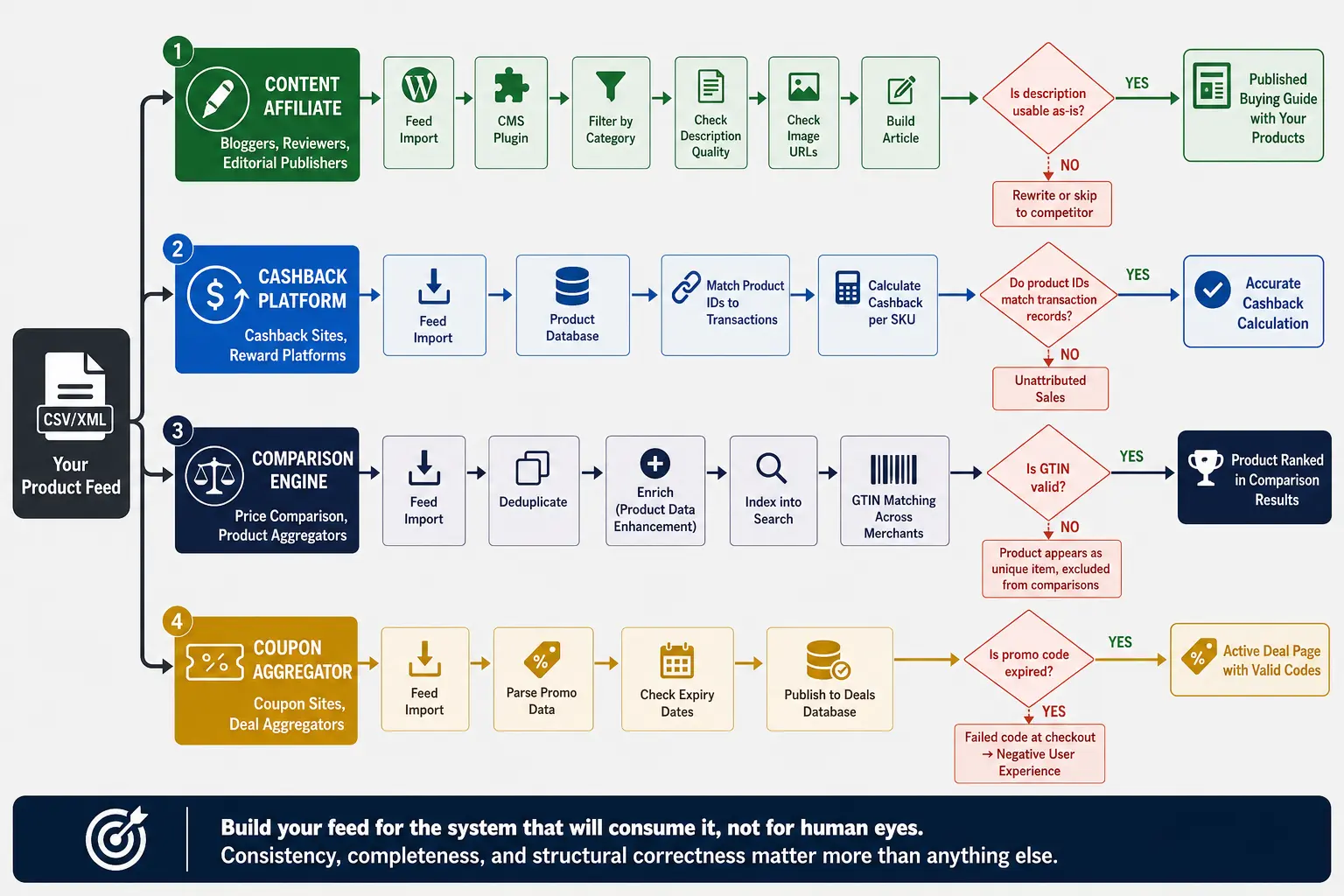
When a content affiliate or comparison site joins your program and downloads your feed, they are not viewing it in a browser. They are loading it into their own technical infrastructure: a content management system, a custom-built product database, a comparison engine, or a cashback tracking system.
For content affiliates building comparison tables or buying guides, the typical workflow pulls your feed into a spreadsheet or a plugin that formats product data into a display template. They filter by category to find the products relevant to their article. They check whether your description is usable as written or needs to be rewritten. They check whether your image URLs return a high-quality image or a placeholder. Then they build their article using your product data as the source.
If your feed has missing descriptions, broken image URLs, or incorrectly formed deep links, the content affiliate hits friction at every one of these steps. They are choosing between spending time fixing your data problems or moving to a competitor merchant whose feed is clean and complete.
For cashback platforms, your feed is ingested into a product database that matches every tracked transaction back to a product record. When a user earns cashback, the platform looks up the product in their database using your product ID and confirms the eligible cashback rate. This matching process breaks whenever product IDs change, products are removed without being marked as discontinued, or price data is inconsistent between the feed and the actual transaction value.
For price comparison engines, your feed is ingested, deduplicated, enriched with any missing data the platform can source, and indexed into their search infrastructure. Every time your feed updates, their system processes the changes. If your feed generates format errors, contains duplicate product IDs, or uses nonstandard characters in field values, it fails validation, and your products go dark until the next successful import.
For coupon aggregators, your feed's promotional data is parsed into their deals database. Expiry dates are used to automatically unpublish expired offers. Discount codes are presented to users during checkout flows. If your promotional codes are expired but still appear in the feed, cashback or coupon users experience failed codes at checkout. This is one of the fastest ways to generate negative reviews about your affiliate program.
The practical takeaway: build your feed for the system that will consume it, not for human eyes. Consistency, completeness, and structural correctness matter more than anything else.
Your feed as an affiliate recruitment tool
Here is a framing that nobody else in this SERP uses: your product feed is a business development asset, not just a technical data file.

High-value affiliates, meaning the publishers and platforms that drive the top 20 percent of affiliate revenue in most programs, evaluate merchant feeds before deciding whether to join and actively promote a program. They have seen enough bad feeds to know that a poorly maintained feed signals a merchant who will not support their partners well.
Here is what experienced affiliates actually look at.
Feed freshness. An affiliate looking at your program can usually see when your feed was last updated. A feed that was last updated three weeks ago tells them that either you are not running active promotions, you are not paying attention to your affiliate program, or your technical setup cannot keep up with your inventory changes. None of those signals encourage a quality affiliate to invest their content creation time in your catalog.
Description quality. A content affiliate reads two or three of your product descriptions before deciding whether your feed will save them work or create it. If your descriptions are duplicate, generic, or copied from manufacturer spec sheets without editing, they know they will need to rewrite everything themselves. That is time they could spend promoting a merchant with better content.
Deep link functionality. Affiliates test your product links before publishing content around them. If a significant percentage of your links return 404 errors, redirect to a category page instead of the product, or do not carry the correct tracking parameters, the affiliate has no way to earn commission from promoting you. This is a disqualifying issue.
Image quality. Affiliates who publish visually driven content, fashion bloggers, home decor reviewers, and tech unboxing channels choose merchants whose product images are worth using. If your images are low resolution, show the product at an angle that makes it hard to understand, or have poor lighting, your products will be used less regardless of how competitive your prices are.
Promotional data. Affiliates who run deal content need to see that your promotional calendar is reflected in your feed. If you run regular sales but your promotional fields are always empty, coupon and deal affiliates assume you either do not run promotions or that your feed is not worth setting up.
The feed quality checklist every top affiliate applies
Before joining or actively promoting a merchant program, experienced affiliates run through a mental checklist: Are the descriptions usable without rewriting? Do the product images work at the sizes I need? Are deep links stable and correctly tracking? Is the feed updated frequently enough for my content type? Are promotions reflected in real time?
Running a feed audit before you actively recruit affiliates tells you exactly how your feed scores on each of these dimensions. Finding and fixing issues before a top affiliate evaluates your program is far better than losing them because they encountered problems you already knew about.
How often your feed should update and what staleness is costing you
Two of the five ranking pages say "update your feed regularly." Neither of them defines what regularly means or what it costs when you do not.

Here are the specifics.
The update frequency matrix by affiliate type
Affiliate type           Recommended update frequency               Why
Content affiliates       Daily                                      Price and availability accuracy for editorial trust
Coupon affiliates        4 to 6 hours during active promotions      Promotional codes and sale prices must be current
Cashback platforms       Every 2 to 4 hours                         Price accuracy is a direct financial obligation
Comparison engines       Daily                                      Pricing position in comparisons affects ranking
What stale data actually costs
Out-of-stock products are still in the feed. When an affiliate drives traffic to a product that is out of stock because your feed has not updated, that click is lost entirely. The affiliate earns no commission. Their user has a poor experience. If this happens repeatedly, the affiliate stops promoting that product category.
A merchant with 500 active products and a typical 10 to 15 percent out of stock rate at any given time has 50 to 75 products actively sending affiliate traffic to pages that cannot convert. Depending on how much traffic those products receive, this can represent a significant portion of lost affiliate revenue that nobody is measuring or reporting.
Expired promotional codes. When a cashback site or coupon affiliate presents your promotional code to a user at checkout and the code does not work, the user blames the affiliate platform, not you. But the platform blames your feed. After one or two incidents with expired codes, the affiliate platform either removes your program from their promotions or adds a manual verification step that delays your deal going live.
Broken deep links. Product URL structures change when sites are redesigned, platforms are migrated, or URL slugs are changed for SEO purposes. When a URL change is not reflected in your affiliate feed, every affiliate who published content with the old URL is now sending traffic to a 404 page. That is lost commission for them and lost revenue for you.
Price mismatches. If a user clicks through from a cashback site that shows a product at £30 and the product page shows £35, the sale either does not happen or happens at the wrong price. For cashback platforms, a price mismatch means their cashback calculation is wrong, which is a direct user complaint and an operational cost they will factor into how prominently they feature your program.
The measurement question
Most merchants have no idea how much stale feed data is costing them because the revenue lost to stale data is invisible. It never shows up as a declined transaction or a disapproval. It simply does not happen.
The FeedOn feed audit identifies out-of-stock products, broken URLs, and pricing inconsistencies across your feed before they reach your affiliate partners, turning invisible revenue losses into fixable problems.
How AI is transforming affiliate feed management in 2026
Every article in this SERP was written before AI fundamentally changed what is possible in product feed management. The newest is from 2024. None of them mention AI once.

Here is what is actually possible now.
AI-generated product descriptions from images
The most time-consuming part of building a high-quality affiliate feed for a large catalog is writing product descriptions that content affiliates can actually use. For a catalog of 2,000 products, that task was previously either manual work across weeks or outsourced to a copywriting service.
AI tools can now scan your product images and existing product data and generate complete, editorial quality descriptions that serve content affiliates directly. The output is not generic boilerplate. Modern AI generation from a tool like FeedOn produces descriptions that include the product type, key features, target use case, material attributes, and the kind of specific detail that content affiliates need to write genuinely useful buying guides.
AI attribute extraction for missing data
One of the most common affiliate feed problems is missing attributes. A product has a title and a price but no color, no material, no size specification, and no category classification beyond the most generic level. Affiliates who rely on those attributes to filter and segment your catalog for their specific audience cannot use these products effectively.
FeedOn's Vision AI scans your product images and extracts missing attributes automatically. Color, material, pattern, and gender classifications are extracted from the image itself, not from the product title, where that data may not exist. For a merchant with 1,000 products missing color data, this transforms a week of manual data entry into an automated process that takes minutes.
AI-powered title optimisation per channel
The title that performs best in Google Shopping follows the structure Brand plus Product Type plus Key Attribute. The title that performs best on a content affiliate comparison table reads more naturally and includes the specific use case. The title that works for a cashback platform needs to be unambiguous and match exactly what is on the product page.
AI title optimization can generate channel-specific versions of your product title from a single master title, applying the correct structure and language for each destination. FeedOn's AI Copy Boosters handle this at scale, rewriting your entire catalog for multiple channel contexts without manual work per product.
Automated broken link detection
AI-powered feed monitoring can detect broken deep links before affiliates encounter them. Rather than waiting for an affiliate to complain that their link is returning a 404, automated scanning checks every URL in your feed on a regular schedule and flags any that are not returning a valid product page. This turns a reactive problem into a proactive maintenance task.
Predictive affiliate performance scoring
Emerging AI feed tools can analyze historical conversion data at the SKU level and predict which products in your feed are most likely to convert for different affiliate types. Rather than presenting your entire catalog equally to all partners, you can give content affiliates a curated selection of your highest-converting products for their audience while giving comparison engines the full catalog.
Feed health monitoring without manual review
A feed with 5,000 products cannot be manually reviewed for quality issues on a regular basis. AI-powered quality monitoring scans your entire catalog every time your feed refreshes and flags anomalies: sudden price changes that may indicate a feed sync error, products with missing required fields that appeared with the last inventory update, and image URLs that are returning lower-resolution images than before. What previously required a dedicated data analyst to catch is now automated monitoring that alerts you when something needs attention.
The AI changes to product feed management article on FeedOn's blog covers the broader shift in detail. The affiliate marketing context adds specific use cases on top of that general picture.
Bad feed vs good feed: what the difference looks like
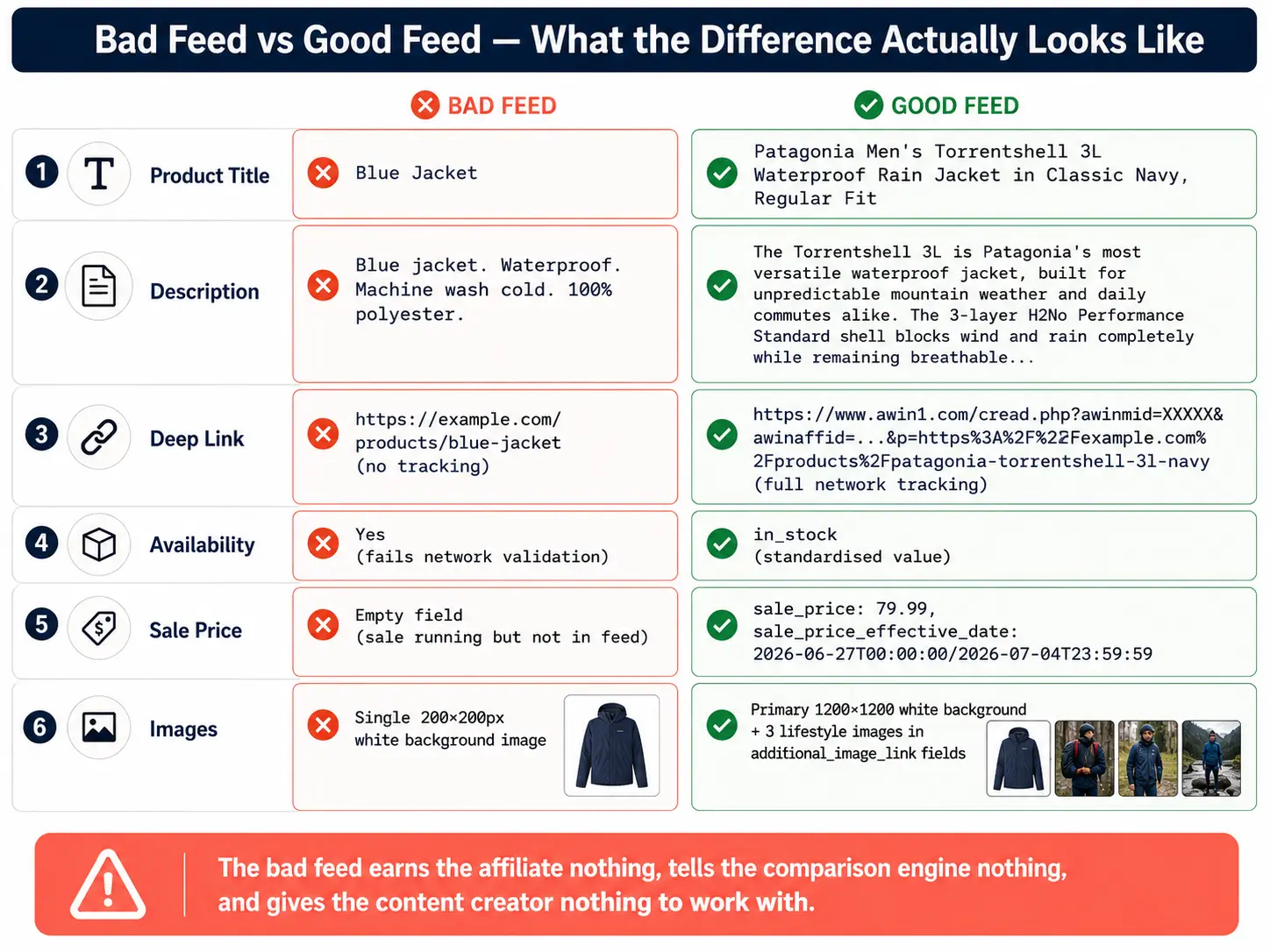
Every article tells you what a good affiliate feed should include. None of them show you the actual before and after at the field level. Here is the concrete comparison.
Product title
Bad: Blue Jacket
Good: Patagonia Men's Torrentshell 3L Waterproof Rain Jacket in Classic Navy, Regular Fit
The bad title tells an affiliate almost nothing they can work with. The good title gives a content affiliate their headline, gives a comparison engine the brand and product type for matching, and gives a coupon affiliate the specific product name to build a deals page around.
Product description
Bad: Blue jacket. Waterproof. Machine wash cold. 100% polyester.
Good: The Torrentshell 3L is Patagonia's most versatile waterproof jacket, built for unpredictable mountain weather and daily commutes alike. The 3-layer H2No Performance A standard shell blocks wind and rain completely while remaining breathable enough for high-exertion activity. The slim-fit silhouette works equally well under a pack as it does over a dress shirt. Available in regular and long fits. Machine wash cold, tumble dry low.
The good description gives affiliate content usable editorial copy, tells a comparison engine the specific features (3-layer, H2No standard, breathable), and gives a buyer the information they need to make a decision without leaving the affiliate's site.
Deep link
Bad: https://www.example.com/products/blue-jacket
Good: https://www.awin1.com/cread.php?awinmid=XXXXX&awinaffid=AFFILIATE_ID&ClickRef=CLICK_REF&p=https%3A%2F%2Fwww.example.com%2Fproducts%2Fpatagonia-torrentshell-3l-navy%2F
The bad link has no tracking, goes to a potentially outdated URL, and would earn the affiliate nothing if it converted. The good link uses the correct network tracking format, links to the specific product with a permanent URL structure, and correctly attributes any sale to the affiliate.
Availability
Bad: Yes
Good: in_stock
Networks have specific accepted values for availability fields. "Yes" fails validation on most networks. Using the standardized values (in_stock, out_of_stock, preorder) ensures your products import correctly and affiliates see accurate availability status in their tools.
Sale price data
Bad: sale_price field left empty even when a sale is running
Good: sale_price: 79.99, sale_price_effective_date: 2026-06-27T00:00:00+00:00/2026-07-04T23:59:59+00:00
Without the sale price and effective date, coupon and cashback affiliates cannot build timely content around your promotions. With it, automated deal sites can launch and expire promotional content on exactly the right schedule.
Image
Bad: 200 x 200 pixel product image with white background only
Good: Primary image: 1200 x 1200 pixel white background product shot. Additional images in additional_image_link: a lifestyle photo showing the jacket worn on a trail, a flat lay showing the packable storage bag, and a detail shot of the zipper and cuff system.
Content affiliates use the additional lifestyle images. White background images alone leave a significant part of your potential affiliate content underserved.
How to measure whether your affiliate feed is working: 6 metrics that matter
Zero of the five ranking pages in this SERP provide a measurement framework. Most merchants have no idea whether their affiliate feed is performing because they are not measuring the right things.

Here are the six metrics that tell you whether your feed quality is costing you affiliate revenue.
Metric 1: Affiliate conversion rate by product
Calculate the conversion rate for each product promoted by affiliates: affiliate clicks divided by affiliate sales per product. Products with significantly lower conversion rates than your average may have feed data problems rather than product problems. If a product converts at 4 percent via direct traffic but 0.8 percent via affiliates, the discrepancy is worth investigating. Is the deep link going to the right page? Is the price in the feed matching the price on the product page? Is the product actually in stock when affiliates are sending traffic?
Metric 2: Deep link click to sale rate
This measures how many affiliate clicks on your product links result in a product page view versus returning a 404, redirecting to your homepage, or landing on an unavailable product. Most affiliate networks provide click data at the link level. A click-to-sale rate that is significantly lower than your overall conversion rate suggests link health problems in your feed.
Metric 3: Out of stock impression rate
Calculate what percentage of your affiliate traffic is going to out-of-stock products. You can build this from your network reports (which products received affiliate clicks) cross-referenced with your inventory data (which products were out of stock at the time of those clicks). A high out-of-stock impression rate tells you your feed update frequency is too slow relative to your inventory turnover.
Metric 4: Feed adoption rate
Of all affiliates who have joined your program, what percentage are actively using your product feed versus manually linking to individual products or not promoting you at all? A low feed adoption rate usually means either affiliates do not know about your feed, the feed is too difficult to use, or the feed quality is low enough that affiliates find it easier to work without it.
Metric 5: Affiliate partner churn rate by feed quality tier
If you segment your products by feed quality (complete data vs. incomplete data), you can track whether affiliates who primarily promote your high-quality feed products stay active longer than those who promote products with poor feed data. This is a leading indicator: if affiliates promoting your worst data are churning faster, improving feed quality is a retention lever.
Metric 6: SKU-level commission distribution
Look at which products are being promoted by affiliates and which are not. Often, the products with the highest commission potential are underrepresented in affiliate content because they have poor feed data. An expensive product with a great commission rate but a two-sentence description and no lifestyle images will be systematically ignored by content affiliates who choose products they can write about effectively.
How to build your measurement baseline
Start with your affiliate network's reporting dashboard. Export product level click and conversion data for the last 90 days. Cross-reference with your feed data to identify which products are receiving affiliate traffic and which are not. Run a feed audit on your existing feed to identify quality gaps. Map those gaps to the products that are underperforming in your affiliate reports.
This process turns "our affiliate program is not growing" from a vague concern into a specific set of data quality fixes with measurable expected impact.
How FeedOn.ai helps you build and maintain a high-performing affiliate feed
Building and maintaining a product feed that serves four different types of affiliates across five major networks while staying fresh enough for cashback platforms and complete enough for content creators is a significant operational commitment.

FeedOn handles the parts of this that do not need to be manual.
Feed audit across 60+ quality checks. Before any feed goes to any affiliate network, FeedOn's feed audit runs 60+ automated checks across your product catalog. It identifies broken image URLs, missing required fields, price anomalies, availability inconsistencies, and duplicate product IDs before they reach your affiliate partners. The audit gives you a quality score per product so you know exactly which items need attention before launch.
AI attribute extraction from product images. FeedOn's Vision AI scans your product images and fills missing attributes automatically: color, material, pattern, gender classification, and product type. For merchants with incomplete product data from their e-commerce platform backend, this bridges the gap between what your store has and what affiliate networks and publishers need.
Multichannel feed publishing from one source. Rather than maintaining separate feeds for Google Shopping, AWIN, CJ, ShareASale, and Rakuten with manual updates to each, FeedOn's multichannel publishing generates correctly formatted feeds for every destination from one central product catalog. When your price changes, it changes everywhere. When a product goes out of stock, every feed reflects that on the next refresh cycle.
AI title and description optimization. FeedOn's AI Copy Boosters rewrite your product titles and descriptions for each channel context. A content affiliate-optimized description is different from a Google Shopping-optimized title, and both are different from the structured data format a comparison engine needs. Generating all three from one source product record eliminates the version management problem entirely.
Continuous feed health monitoring. FeedOn monitors your feed health on an ongoing basis, not just at the point of initial setup. Broken links, price mismatches, newly out of stock products, and attribute quality degradations are flagged automatically so your affiliate feed does not silently deteriorate between your manual review cycles.
If you are building your affiliate program feed from scratch or auditing an existing one, the logical starting point is understanding your current data quality. Run a free FeedOn feed audit on your existing product catalog before submitting to any affiliate network. It takes five minutes and shows you every issue you would otherwise discover the hard way after a network rejects your feed or an affiliate complains about your data.
Frequently Asked Questions
What is a product feed in affiliate marketing?
A product feed in affiliate marketing is a structured data file that merchants provide to their affiliate partners, containing all the product information affiliates need to promote the merchant's catalog accurately. It includes product titles, descriptions, images, prices, availability, deep links with tracking parameters, and promotional data. Affiliates use this feed to display products on their websites, comparison engines, cashback platforms, and deal sites without having to manually update product information.
Can I use my Google Shopping feed for affiliate networks?
You cannot use your Google Shopping feed directly for most affiliate networks without modification. Google Shopping feeds do not contain affiliate tracking parameters in the product URLs, use Google's category taxonomy rather than the affiliate network's taxonomy, and are missing affiliate-specific fields like promotional codes and promotional expiry dates. Impact is the one major network that accepts Google Shopping XML format as a base, but even there you need to add tracking parameters and promotional fields. The right approach is to generate both your Google Shopping feed and your affiliate network feeds from the same master product catalog using channel-specific transformations.
How often should I update my affiliate product feed?
Update frequency depends on your affiliate type mix. For content affiliates, daily updates are sufficient. For coupon and deal affiliates, update every 4 to 6 hours during active promotions. For cashback platforms, update every 2 to 4 hours. For price comparison engines, daily updates are standard. If you have cashback partners, they should be your update frequency benchmark because they have the strictest requirement for pricing accuracy.
What makes a product feed attractive to top affiliates?
High-quality affiliates evaluate five things before deciding to actively promote a merchant: the quality and completeness of product descriptions, the resolution and variety of product images, the stability and accuracy of deep links, the freshness of pricing and availability data, and whether promotional data is current and reflected in the feed. Meeting all five criteria distinguishes merchants that top affiliates choose to promote from the majority of programs they ignore.
How do I measure whether my affiliate product feed is performing?
Measure affiliate conversion rate by product to identify products where feed data quality may be suppressing sales. Track deep link click-to-sale rates to identify link health problems. Monitor out-of-stock impression rates to catch feed freshness issues. Review SKU-level commission distribution to find high-potential products that affiliates are not promoting due to poor feed data. These four metrics together tell you where your feed is costing you affiliate revenue.